
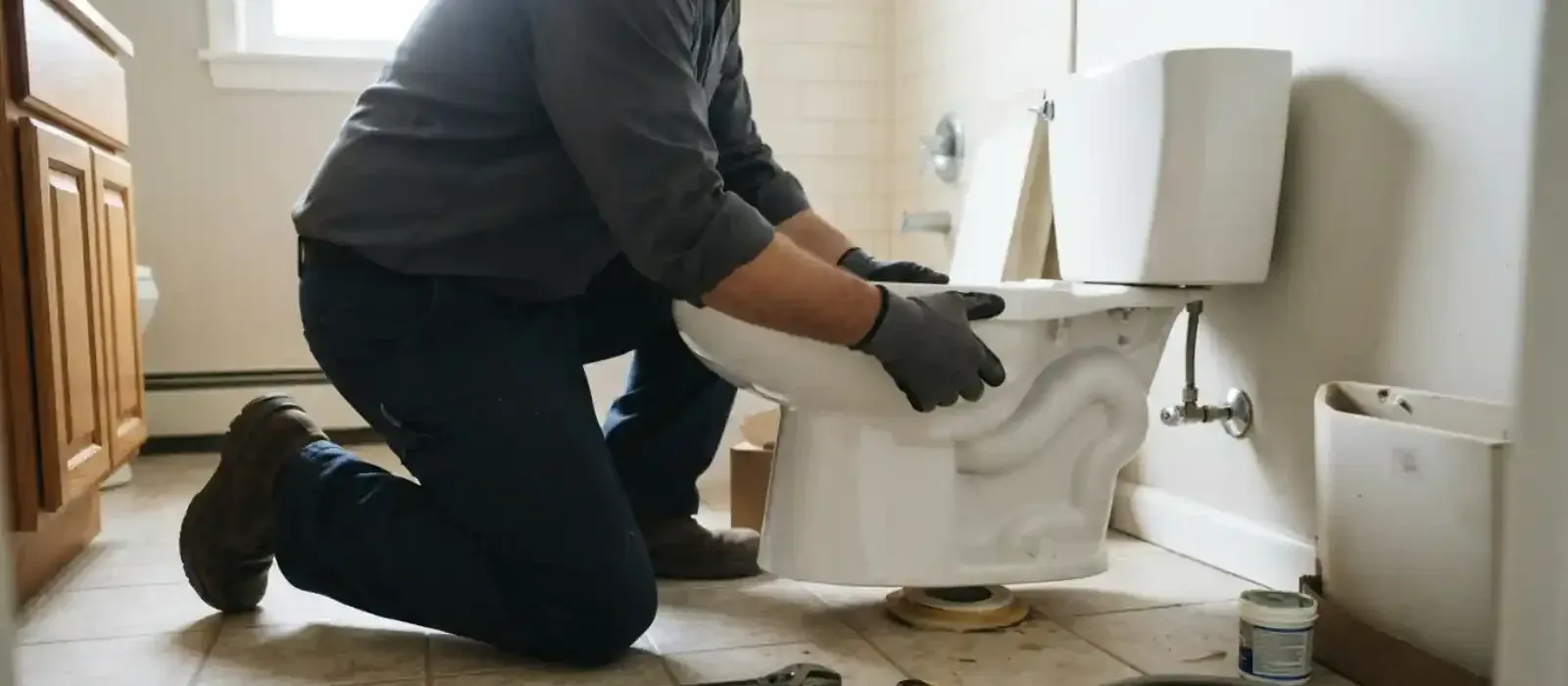
Check three things before you buy a toilet
Most failed installs go wrong before the new toilet is out of the box. Measure the rough-in, which is the distance from the finished wall to the center of the floor drain. Many bowls fit a 12 inch rough-in, but 10 and 14 inch layouts exist, and a mismatch leaves the tank sitting crooked against the wall.
Then look at the flange, the ring on the floor that the toilet bolts to, and press down on the floor around it. If the floor flexes or the flange moves, read the flange section below before you spend money on a bowl.
Pre-purchase checklist
- Rough-in distance: measure from the wall behind the tank, not the baseboard, to the center of the closet bolts.
- Bowl shape: round or elongated, based on how much room you have in front of the toilet.
- Shutoff valve: turn it fully off and back on. If it drips at the stem or will not close, replace it first.
- Floor: push down near the base. A soft spot means water has been soaking the subfloor.
- Help: a full-size toilet is heavy and slick, so line up a second person for the carry.
Tools and parts to have on the floor first
Hand tools
An adjustable wrench, a putty knife, a level, a screwdriver and a hacksaw for trimming long closet bolts. A small bucket and a sponge handle the water left in the old bowl.
Parts
New closet bolts, a wax ring or wax-free seal, a braided supply line and plastic shims. Never reuse the old ring, because it keeps the shape of the old toilet and will not seal a new one.
Safety gear
Rubber gloves and safety glasses. Old closet bolts can snap, and the old wax carries residue you do not want on bare skin.
A rag for the drain
Stuff a rag into the open flange once the old bowl is off. It blocks sewer gas and stops a dropped nut from falling down the pipe. Pull it out before you set the new seal.
Install the toilet in six steps
Shut off and drain
Turn the shutoff valve clockwise until it stops. Flush, hold the handle down and sponge the last water out of the tank and bowl. Disconnect the supply line with a wrench and keep a rag under it for the drips.
Unbolt and lift
Pop off the caps and remove the nuts on the closet bolts. Rock the bowl gently to break the old seal, then lift straight up with a helper and set it on cardboard or a towel.
Clean and inspect the flange
Scrape the old wax off with a putty knife and plug the opening with a rag. Look for cracks, rust, broken bolt slots and a flange sitting below the finished floor.
Set the bolts and the seal
Slide new closet bolts into the flange slots and square them up. Press the wax ring onto the flange or the bowl horn, following the package, and pull the rag out of the drain.
Lower the bowl
Line the holes up with the bolts and set the bowl straight down in one motion, without twisting. Press down with your body weight to compress the seal, then check it with a level. Use plastic shims under the base if the floor is uneven.
Tighten, connect and test
Snug each nut a little at a time, alternating sides. Porcelain cracks, so stop once the bowl no longer rocks. Mount the tank if it is separate, connect the supply line, open the valve slowly and flush several times while you watch the base and fittings for moisture.
Trim the bolt ends and snap on the caps last. Check the base again the next day. A slow weep at the floor is the earliest sign of a poor seal, and resetting a bowl in week one costs far less than replacing rotted subfloor later.
The flange decides whether this is a DIY job
The flange is a ring of plastic, cast iron or brass fixed to the drain pipe. The toilet seals against it through the wax, so its height and condition matter more than any other part. The target is a flange that sits about level with the finished floor, or a little above it.
A flange you can work with
- Firmly screwed to a solid subfloor
- No cracks around the bolt slots
- Sits at or slightly above the finished floor
- No rust-through and no wobble
A flange that needs a plumber
- Cracked or broken at the slots
- Sitting well below new tile or vinyl
- Corroded cast iron or a pipe that moves
- Soft or stained wood around it
Repair rings and spacers exist, and a handy owner can fit some of them. A flange attached to a failing drain, rotted subfloor or crumbling cast iron is different. A patch there hides a leak under the floor, and that is where a toilet repair visit pays for itself.
Opened the floor and not sure what you found?
Describe what you see to dispatch on (860) 397-8103. A licensed plumber can tell you whether the flange is a quick fix or a bigger repair, and you hear a clear price before work starts.
Wax ring or wax-free seal?
| Seal type | Where it fits | Watch for |
|---|---|---|
| Standard wax ring | Flange at or just above the floor | One use only. Lift the bowl again and the ring must be replaced. |
| Extra-thick wax ring | Flange slightly below the floor | It covers a low flange but does not fix it, so ask whether a proper repair is better. |
| Wax-free rubber or foam seal | Owners who may need to reset the bowl | Follow the maker's instructions on flange height and bolt position. |
| Offset flange fitting | Drain slightly off center | Needs careful cutting and sealing, so many people hand this one off. |
Old shutoff valves in Farmington homes
The valve under the tank is the part most likely to ruin your Saturday. Census Bureau estimates for 2020 to 2024 put Farmington's median home at 1980, and roughly 25 percent of homes date from before 1960. Plenty of shutoff valves in town have sat untouched for decades, and old multi-turn valves can drip at the stem or refuse to close.
Test the valve before you commit
Close the valve and flush. If water keeps trickling into the tank, the valve is not sealing. Shut the main valve, usually near the water meter, and replace the toilet valve first. Forcing a stuck handle can snap the stem and start a leak you cannot stop.
Ask the building department before you lift the old toilet
Farmington's building department says permits are applied for online and that its inspections cover plumbing. Connecticut's 2022 State Building Code says an owner who plans to alter, repair or replace a plumbing system regulated by the code must first apply to the building official. The town's published pages do not say whether a like-for-like toilet swap counts.
Permit rules vary, so ask. The Building Department inspection line is 860-675-2315, and a short call settles it for your address. If you hire a plumber, ask the same question and check the license on the state's eLicense lookup.
Source type: municipal building department page and state building code
When to hand the job to a licensed plumber
Call a plumber if the flange is damaged, the floor is soft, the shutoff will not close, the new toilet rocks after you tighten it or the drain backs up on flushing. Those signs point to a problem under or behind the toilet, not just a tired seal. Moving a toilet or adding a bathroom means new drain and vent runs, which is plumbing installation rather than a swap.
Housing age nearby makes the same point. In West Hartford, Census figures show about 65 percent of homes were built before 1960, so original valves and flanges are common. In Plainville, utility-reported data compiled by TapWaterData lists about 9.5 grains per gallon for the Aquarion system, classed hard, which can leave scale on a new fill valve.