
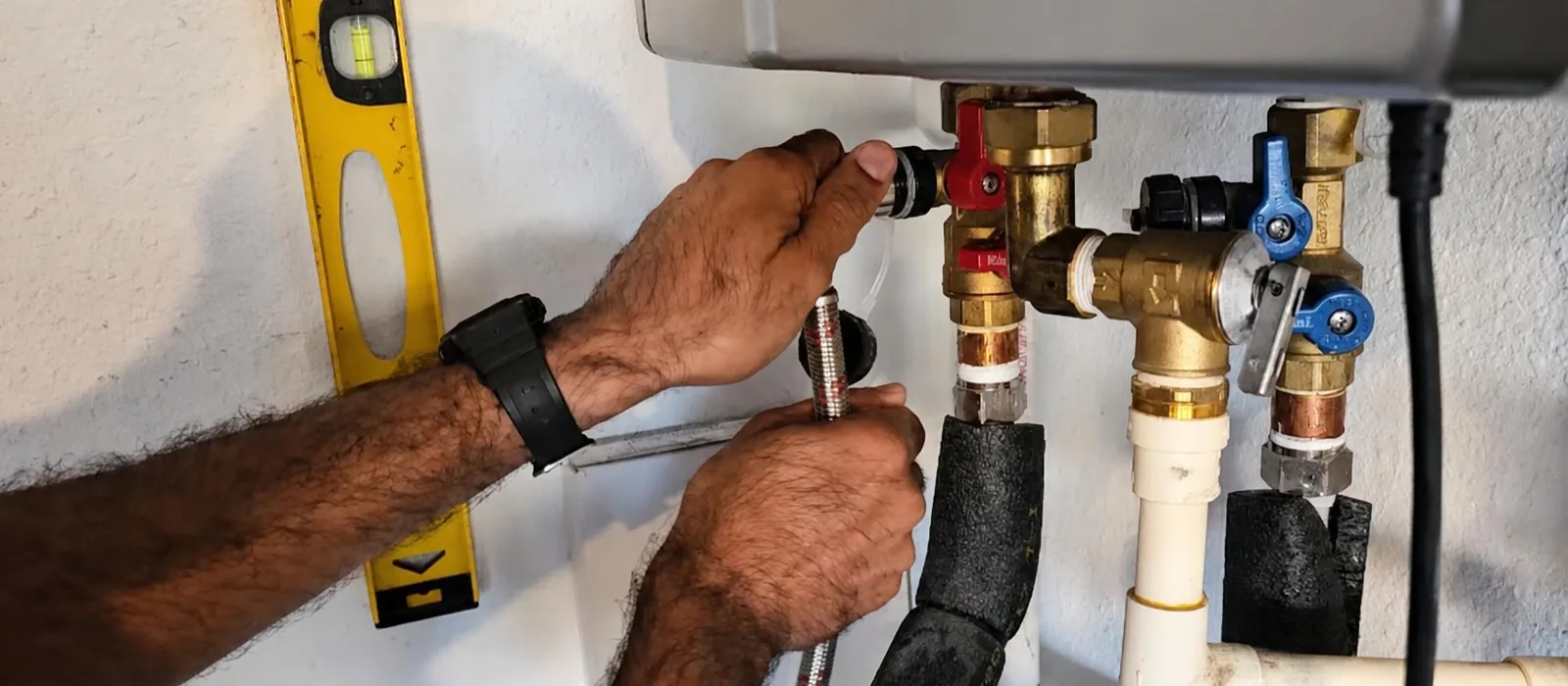
Hot water that fades, flips cold or never arrives
Most tankless complaints start as a symptom, not a part name. Showers that turn lukewarm when the dishwasher starts, a cold blast between two bursts of hot, or a long wait at the far bathroom all have different causes.
Use the table to match what you notice to the likely reason, then call for a visit.
| What you notice | Likely cause | What we check |
|---|---|---|
| Hot water fades with two fixtures on | Unit is undersized for peak flow | Rated flow rate against actual demand |
| Cold sandwich between hot bursts | Short draws that never trigger the flame, or scale | Minimum flow, sensors and the inlet screen |
| Long wait for hot at one bathroom | Long pipe run, not the heater | Distance and a possible recirculation loop |
| Error code on the display | Flame, vent, flow or temperature sensor fault | Venting, gas supply and sensor readings |
| Hot water gets weaker over months | Scale on the heat exchanger | Flush, as described below |
Is tankless right for a Farmington house?
Where tankless shines
- Hot water on demand with no standby tank to keep warm
- Frees up floor space in a basement or utility closet
- Good for steady households that never use many fixtures at once
- A gas unit recovers instantly once the flame lights
Where it needs planning
- Gas models can need a larger gas line and special venting
- Electric models draw a lot of power and may need a service upgrade
- Peak demand from two showers and a washer is the main limit
- Descaling is a recurring task, not a one-time job
A gas tankless unit needs a larger gas supply than most tank heaters, so the plumber checks the gas line size first. For an oil household, a boiler-fed indirect tank or an electric tankless model are both worth discussing. If you are unsure, our water heater installation page covers sizing and fuel in more detail.
Descaling and flushing a tankless heater
Water leaves minerals on the heat exchanger of a tankless unit. Over time those deposits narrow the passages, reduce flow and trigger error codes.
A flush circulates a descaling solution, usually white vinegar or a manufacturer-approved product, through the unit with a small pump and two hoses. We also clean the inlet screen and check the vent, the condensate drain and the gas pressure.
How often, and how would I know?
Mineral content depends on your utility and your source. We cannot give a figure for your tap, so test your water or ask your utility for its annual water quality report. In Farmington that may be Connecticut Water's Unionville or Chimney Hill system, so check your bill.
Follow the maker's schedule in your manual, and flush sooner if flow drops or error codes appear.
Standards that apply to tankless units
Connecticut's 2022 State Building Code adopts the 2021 International Plumbing Code (IPC), and an electric tankless unit also has to meet the 2020 National Electrical Code (NEC) that Connecticut adopted, because these heaters draw a large dedicated circuit. Gas units follow the manufacturer's venting and gas-sizing instructions. Ask for both before you buy.
What to do if a tankless heater shows an error or smells wrong
- Turn the unit off at the switch or breaker and close the gas valve if it is gas-fired.
- Leave the area and call the gas utility or 911 if you smell gas or see soot. Do this before calling a plumber.
- Never disable a safety device or run the unit with the cover off.
- Write down the error code shown on the display so the plumber can plan the repair.
- Shut the cold-water inlet if water is leaking from the unit, then call the 24/7 line.
Tankless acting up?
Describe the symptom and the error code on the display. We will book a visit and quote the work before it starts.
What a service visit includes
Read the history
We record the model, the error codes and when the problem started.
Check the supply
Gas pressure, inlet water pressure and the inlet screen are tested first.
Inspect venting
Blocked vents or condensate drains cause shutdowns, so we trace the path.
Flush the exchanger
If scale is present, we descale and rinse until the water runs clear.
Test and explain
We run a hot water draw, confirm the temperature setpoint and tell you what to watch.
Switching from a tank to tankless
A switch often changes more than the heater. Gas lines may need upsizing, flues may need stainless venting, and electric models can need new breakers. Ask about a tank replacement as the simpler alternative if your budget or your house limits the upgrade.
Permit rules vary, so ask the Farmington building department before work begins, or your own town if you live in Plainville. Connecticut licenses plumbers through the Department of Consumer Protection, and you can check any license on the eLicense lookup.
What moves a tankless quote
Costs come from the house more than from the box. These are the pieces we price.