
Water rising in the bowl: your first two minutes
Do this while you wait for the plumber
Stop the water first and figure out the cause second.
- Close the shutoff valve. Turn the oval handle on the small supply line behind the toilet clockwise until it stops. If it will not move, close the main water valve instead.
- Lift the tank lid. Press the rubber flapper down onto its seat, or raise the float, so no more water enters the bowl.
- Do not flush again. Every flush sends more water toward a blocked drain and onto your floor.
- Protect the room. Lay towels at the base of the bowl and stay clear of wet outlets, floor fans and power strips.
- Check the other fixtures. If the tub or a nearby sink gurgles too, the trouble is deeper than the toilet. Stop using water and tell dispatch.
The line runs around the clock, so a toilet that floods at 3 a.m. gets the same answer as one that floods at noon. Tell dispatch what the water looks like. Clear water points to a fixture fault. Dark or foul water points to a drain problem.
What is actually going wrong inside the toilet
Running or hissing
A worn flapper or a fill valve that will not close lets water trickle into the bowl all day. The tank refills in short bursts, and your water bill is usually the first clue.
Weak or slow flush
Mineral crust in the rim jets, a low tank water level or a partial clog leaves the bowl half cleared. A plumber checks the tank level and the siphon jet before blaming the drain.
Rocking bowl
A loose toilet means the closet bolts or the flange under the floor have shifted. Left alone, the rocking breaks the wax seal and the leak begins.
Water around the base
A failed wax ring or a weeping supply line shows up as damp flooring beside the bowl. Slow leaks here soften the subfloor over time.
Cracked tank or bowl
Hairline cracks seep, then split. A cracked porcelain body cannot be patched for long, and replacement is the honest answer.
Clogs that keep returning
If more than one drain in the house runs slow, the blockage may sit in the line beyond the toilet, not in the bowl.
Repair it, replace it or reset it
Repair makes sense when
- The porcelain is sound and only the flapper, fill valve or handle has failed
- The leak is at the supply line or the shutoff valve
- The bowl rocks but the flange and floor are solid, so a new wax seal and tight bolts fix it
- The toilet is a modern low-flow model that flushes well when its parts are fresh
Replace makes sense when
- The tank or bowl has a crack, even a fine one
- You have needed repeated repairs and the flush still struggles
- The flange or subfloor needs work anyway, so the bowl comes up regardless
- You want a taller bowl, a different rough-in match or a quieter flush
Most toilet repairs take one visit because the common parts are standard. A reset, where the bowl is lifted, the flange inspected and a fresh wax seal set, is the middle path when the leak is at the floor but the porcelain is fine.
What to do when a toilet is overflowing
- Lift the tank lid and push the flapper down to stop more water entering the bowl.
- Close the shutoff valve behind the toilet by turning it clockwise.
- Stop flushing and keep people away from the floor if the water is dirty.
- Do not use chemical drain cleaner and then a plunger, because splashes can burn skin.
- Call the 24/7 line if the valve will not turn or sewage is backing up in other drains.
Toilet still running, leaking or overflowing?
Dispatch answers every hour, books same-day visits when a crew is free and gives you a clear price before the work starts.
Farmington bathrooms and the pipes beneath them
Census estimates for 2020 to 2024 put the median Farmington home at 1980 construction, and roughly a quarter of the housing stock predates 1960. Houses from the older group often have cast iron drains and original closet flanges that corrode or crack. A new toilet set on a damaged flange will rock and leak again, so the flange is checked on every install.
When a toilet keeps backing up after the bowl is cleared, look further down the line. A sewer line cleaning visit with a drain cable or a sewer camera can separate a bowl problem from a main line problem, and a basic drain cleaning call covers the branch lines in between.
Is your street on public sewer?
Farmington's town sewer is run through its Water Pollution Control Facility, and the Town Engineer handles sewer permits. If you are unsure whether your home connects to public sewer or a private septic system, ask the Town Engineer before a repeat backup sends you looking at the wrong pipe.
Setting a new toilet, step by step
Match the rough-in
The rough-in is the distance from the finished wall to the center of the floor drain. A plumber measures it so the new bowl sits flush and the tank clears the wall.
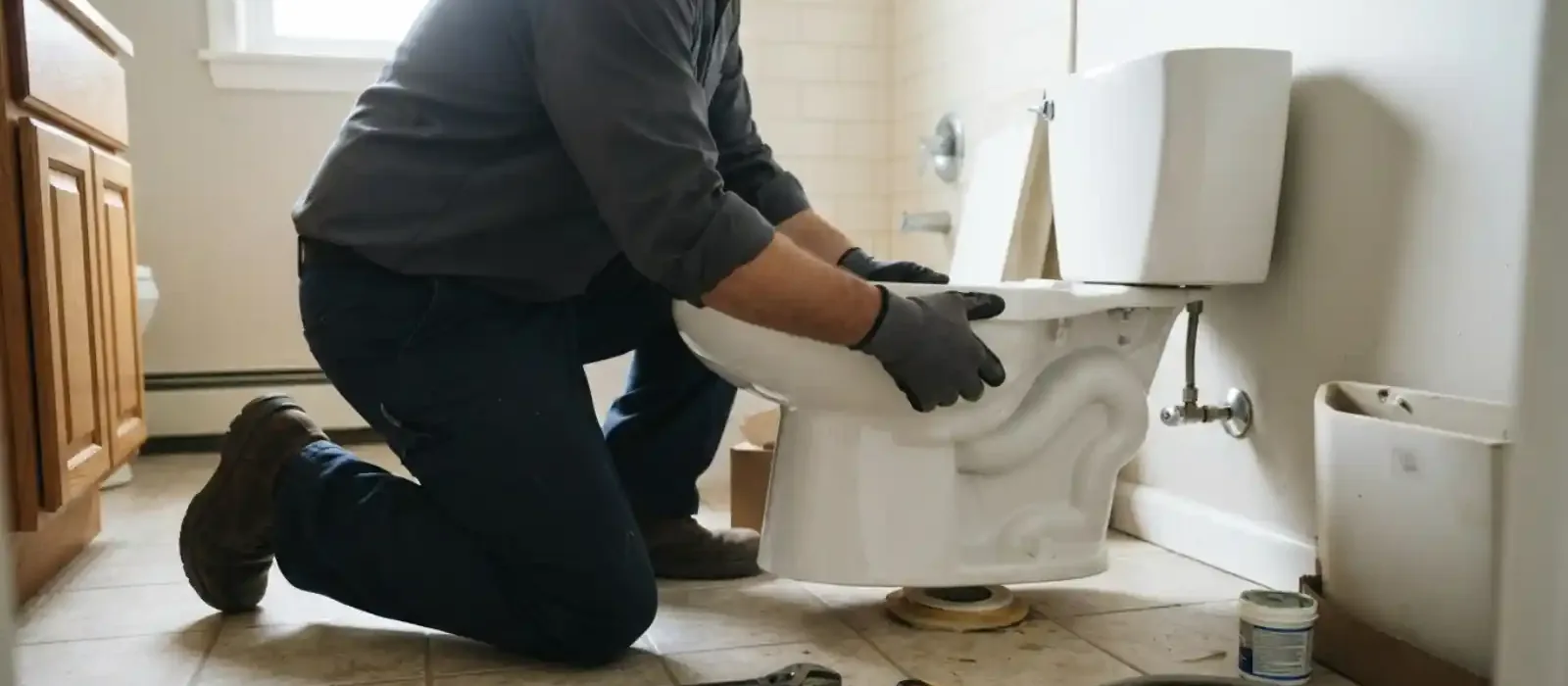
Pull the old toilet
Water is shut off and drained, the closet bolts are removed and the bowl is lifted. The old wax is scraped clean and the flange is inspected for cracks, rust and level.
Repair the flange if needed
A broken flange ring gets a repair ring or replacement. A flange set below the finished floor is raised so the seal compresses properly.
Set, connect and test
The bowl goes onto a new wax seal, the bolts are snugged evenly and a new supply line is attached. The plumber flushes several times and checks every joint for seepage.
Permit rules vary, so ask the Farmington building department whether your particular job needs one. A licensed plumber can tell you what the work involves. You can also verify any plumber's license on the state's eLicense lookup at elicense.ct.gov.
What goes into the price of a toilet job
A toilet job can be as small as a flapper swap or as large as a flange rebuild and a new bowl, so the scope sets the price. These are the factors that move it.
Call (860) 397-8103 for your number. A clear price comes before any work starts.
When a toilet problem cannot wait until morning
Call at any hour if water is spreading, if the shutoff valve will not close, if sewage is coming up or if the leak is dripping into a room below. Dispatch is open nights and weekends, and same-day appointments are offered when a crew is available.
A toilet that only runs, weeps slightly or flushes weakly can often wait for a daytime visit, as long as the supply is shut off when nobody needs the bathroom. If you have two baths, you can close one valve and keep the second in use.