
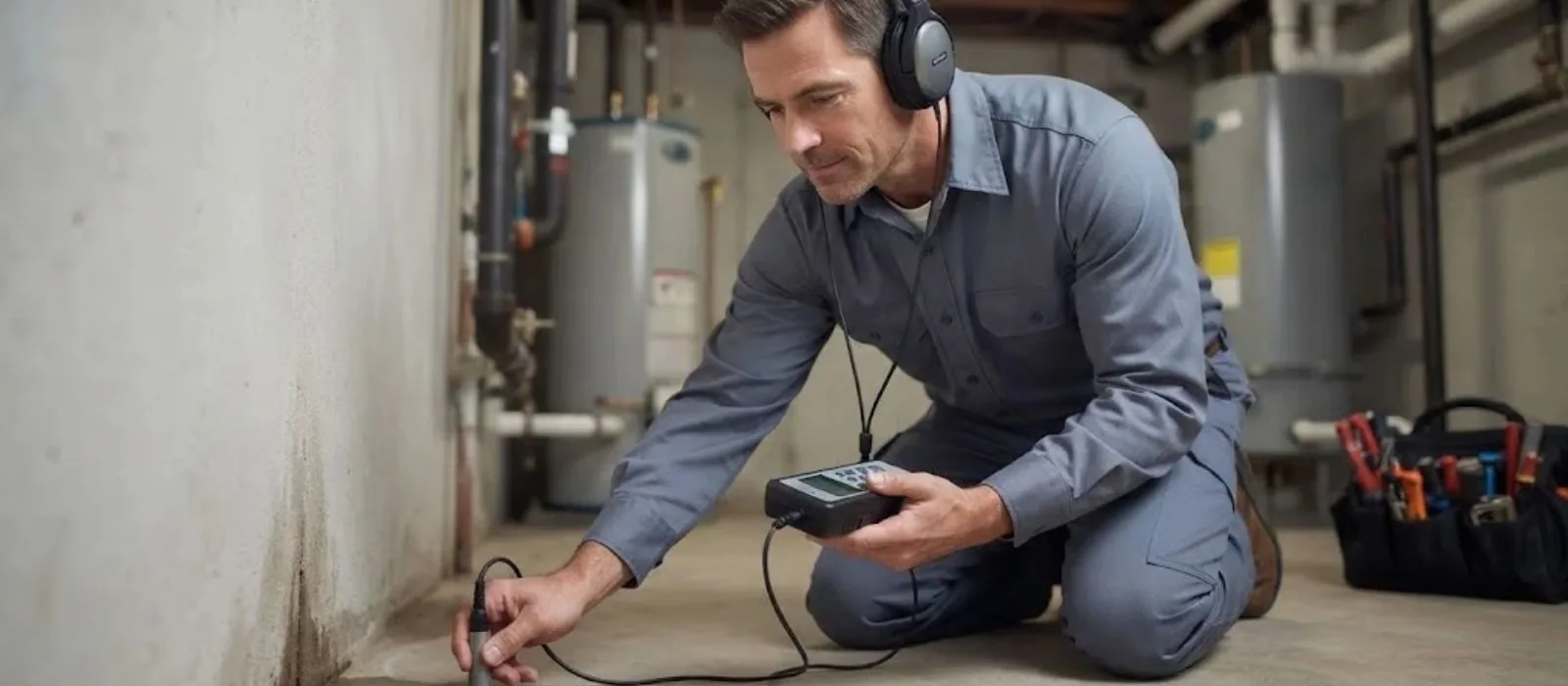
Is water escaping somewhere you cannot see?
Hidden leaks rarely announce themselves with a puddle. They show up as small changes that add up, and most homeowners notice the bill or the smell before they ever see water. Here are the signs that usually mean a supply or drain line is leaking inside a wall, a floor or the ground.
A bill that climbed
Your usage jumped but nobody has moved in, filled a pool or watered more. A steady drip from a pressurized pipe can run all day and all night.
A meter that will not sit still
With every faucet and appliance off, the meter dial or low-flow indicator still moves. That points to water escaping somewhere past the meter.
Warm or damp floor patches
A spot of floor that feels warmer than the rest, or carpet that stays damp, can mean a hot water line is leaking below it.
Musty smell, no visible source
A closed-in damp smell in a closet, basement corner or cabinet often arrives weeks before any stain does.
Hissing or trickling at night
When the house is quiet and the dishwasher is idle, running water inside a wall is easy to hear.
Pressure that sags
Showers that weaken for no reason can mean a pipe is losing water before it reaches the fixture.
Water meter still running? How to check for a high-bill leak
The water meter is the fastest way to tell whether a leak exists at all. You do not need tools, only ten quiet minutes. If the dial moves while everything is off, water is leaving the system somewhere between the meter and your fixtures.
Shut everything off
Stop the dishwasher, washing machine and ice maker, and make sure nobody flushes or runs a tap.
Find the meter
It is usually in the basement near where the line enters the house, or in a box near the street.
Read the dial
Note the numbers, or watch the small low-flow indicator that spins with even a thin stream of water.
Wait, then compare
Check again after thirty minutes without using water. Any change means a leak is real and worth tracing.
Rule out the toilets
A few drops of food coloring in each tank, left alone for fifteen minutes, show whether a flapper is leaking into the bowl.
If the toilets pass and the meter still moves, the leak is in a supply line, a water heater connection or a buried pipe. Shut the main valve and see whether the dial stops. That one test tells a plumber a lot about where to start looking.
When a hidden leak is an emergency
A slow drip can wait for a scheduled visit. Water that is actively spreading cannot. Treat it as urgent if it is soaking a ceiling, pooling near the electrical panel, running down inside a wall or reappearing after you mop it up.
Our line runs 24/7, so a night or weekend discovery does not have to sit until Monday. Same-day appointments are offered when a crew is free, and after-hours callers get the same clear price before work starts.
While you wait for the plumber
These steps limit damage and keep everyone safe until help arrives.
- Close the main valve. Turn it clockwise until it stops. If you are unsure which valve it is, shut the one closest to the meter.
- Protect the electrical side. Keep people away from wet outlets, fixtures and the panel. If the panel itself is wet, stay out and call the utility or 911.
- Move belongings. Lift boxes, rugs and electronics off wet floors and away from the affected wall.
- Photograph everything. Take pictures of stains, the meter reading and any water on the floor before you clean up.
- Open a water-supply fixture. Running one faucet at the lowest point of the house helps drain the line and lowers pressure on the leak.
Stains on ceilings and bubbling walls
A brown ring on a ceiling or a soft, bubbled patch of drywall is the end of a trip, not the start of one. Water travels along joists, pipes and framing before it shows itself, so the stain is often several feet from the real source. A kitchen or bathroom directly above is a strong suspect, as are the supply lines of an upstairs washer.
Do not cut out the stain first
Opening drywall right under a stain tends to find wet material and no leak. A moisture meter and a thermal camera show where the wet area begins and which direction it runs, so the repair can start at the cause. That usually means one small opening instead of several large ones.
Crawlspace and under-floor leaks
Under a floor you may find supply lines, drain pipes and the water heater feed all in a few feet of space. Leaks there run for a long time because nobody looks. Signs include a sagging floor, a musty smell that gets worse after laundry day and mold on joist ends. Wood framing that stays wet attracts rot, so a leak under the floor is worth chasing even when upstairs looks fine.
Some homes also have a concrete slab section, such as an addition or a garage. A leak under slab is found by listening and pressure testing, then repaired by tunneling, opening the slab or rerouting the line above it.
Leaks in buried lines outside the house
A buried water line leaks into soil, so the only clues may be a soggy strip of lawn, a high bill or low pressure. The pipe from the street to your house carries full pressure all day. A small hole there can lose far more water than a faucet drip inside.
Acoustic listening picks up the sound of water escaping from the pipe, and a plumber follows that sound along the route to mark a dig point. Before anyone digs, call 811 or go to CBYD.com. The call is free, it is required by state law and you must place it at least two full business days ahead of mechanized digging.
Where the repair is and who is responsible for it depends on where your water utility's responsibility ends, so ask the utility before you commit. Once the leak is pinpointed, our water line repair page explains trench and trenchless options.
Detection first, licensed repair second
Finding a leak and fixing it are separate steps. Repairs fall under the 2021 International Plumbing Code (IPC) that Connecticut's 2022 State Building Code adopts, and the person making them needs a Connecticut plumbing license. You can check that on the Department of Consumer Protection's eLicense lookup.
Suspect a leak but not sure where?
Describe what you are seeing and the dispatcher will tell you whether it can wait for a same-day visit or needs attention tonight.
How a plumber traces a hidden leak
| Method | What it detects | Best for |
|---|---|---|
| Moisture meter | Wet drywall, wood and subfloor by electrical resistance | Stains on ceilings and walls |
| Thermal camera | Temperature differences caused by hot or cold water | Hot water lines, radiant paths |
| Acoustic listening | The sound of water escaping from a pressurized pipe | Buried lines and under-slab runs |
| Pressure test | A pipe that cannot hold pressure when isolated | Confirming which line is leaking |
| Sewer camera | Cracks, offsets and root intrusion in drain lines | Drain leaks, see sewer inspection |
| Tracer gas | Gas escaping through a leak point and rising to the surface | Cases where sound is unclear |
Most jobs use two or three of these together, because one instrument rarely tells the whole story. A thermal camera finds the warm path, a meter confirms moisture and a pressure test proves which line is the culprit.
What Farmington's age and water systems mean for leaks
Census Bureau estimates for 2020 to 2024 put Farmington's median year built at 1980, and roughly a quarter of the town's 11,837 housing units predate 1960. That is two very different plumbing generations in one town. Older homes tend to show leaks at aging joints and worn valves, while newer homes more often leak at water heater connections and fixture supply lines.
Water service is split as well. Connecticut Water's Unionville and Avon systems and its Chimney Hill system, which buys from the MDC, serve different parts of town. Check your bill to see which one is yours, because the utility's meter is the starting point for the high-bill test above.
If you live in Plainville or are across the line in West Hartford, the same checks apply, although your water utility will be different. See our Plainville page for that side. Winter adds its own risk, because Bradley Airport's January normal low is 18.8 F, and a pipe that splits quietly in a cold exterior wall can leak for days. For a visible split, see burst pipe repair.
Sprinklers, pools and the meter box
Irrigation leaks hide under lawns and look like patches of lush grass or soft soil near a zone valve. Pop-up heads, valve diaphragms and buried fittings are the usual failure points. Connecticut requires a backflow device on many sprinkler systems, so a leak near the backflow preventer deserves a look.
Pools and spas lose water to evaporation, which makes real leaks hard to confirm. A bucket test, with water level marked inside and outside the pool, separates the two. Standing water around the meter box can mean a failed connection on the line.
What goes into the price of finding a leak
Cost factors for leak detection and repair
Locating a leak and repairing it are priced separately, because detection can finish in a short visit while repair depends on where the pipe is.