
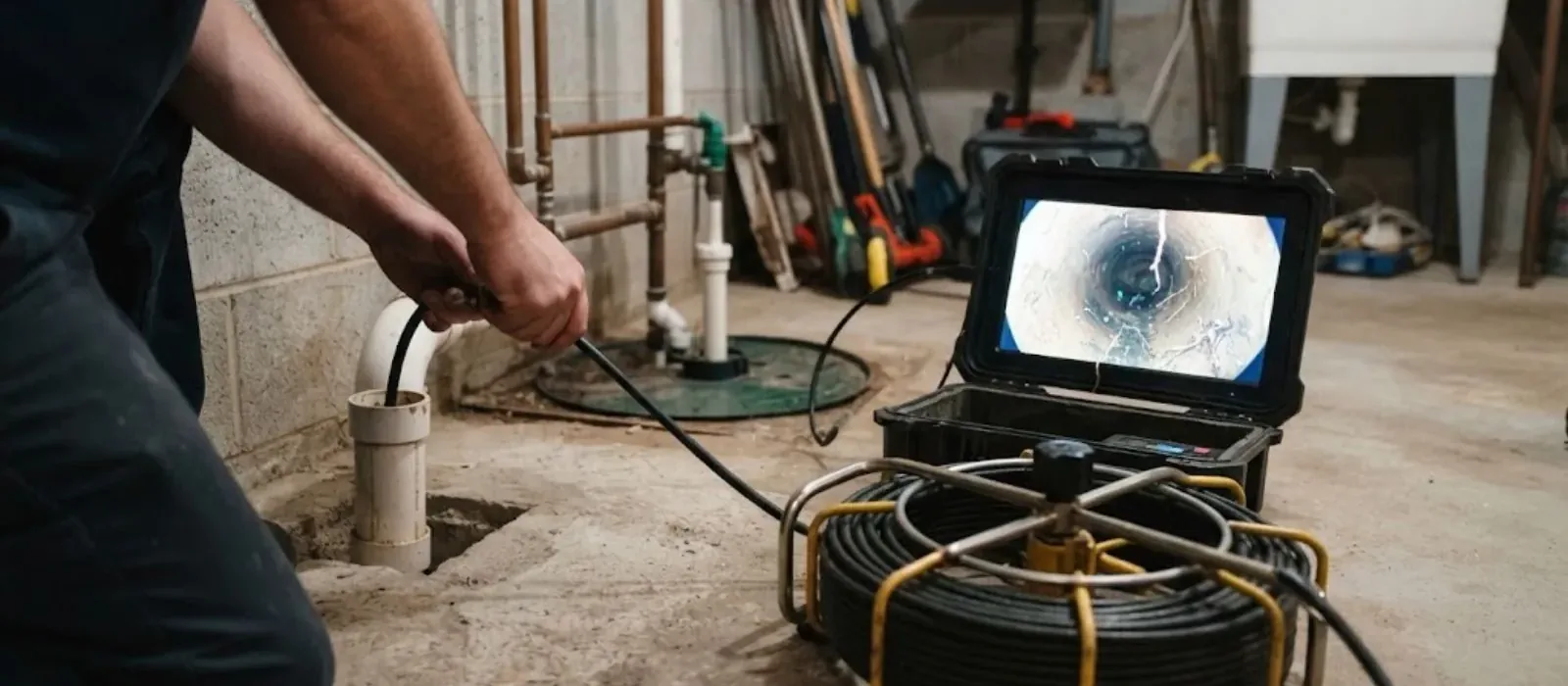
What a sewer camera sees that a cleanout cannot
A cleanout lets a plumber reach the line, but it cannot show what the line looks like. A sewer camera on a push cable records cracks, offset joints, sags that hold water, root intrusion, scale and the point where the pipe changes material. A locator tracks the camera head above ground, so each defect gets a depth and a position along the line.
That record turns a guess into a plan. It tells you whether you need cleaning, a spot fix, lining or nothing at all.
Cracks and breaks
A longitudinal crack and a broken ring look different on camera and call for different repairs.
Belly or sag
A low spot holds water and waste, so it clogs again after every cleaning.
Roots
Fine roots at a joint mean the joint leaks. A thick mass can block the pipe.
Scale and corrosion
Rust buildup narrows older iron pipe and can flake off in chunks.
Offset joints
Shifted pipe ends catch debris and let soil in.
Buying an older Farmington house: scope the sewer before closing
Census Bureau ACS estimates for 2020 to 2024 show 2,910 of Farmington's 11,837 housing units went up before 1960, and 1,211 of those before 1940. A general home inspection usually does not put a camera in the sewer. If the seller cannot say when the line was last cleaned or replaced, a video report gives you a repair estimate to negotiate with before you sign.
Worth scheduling
- Home built before 1960 or with unknown pipe material
- Large trees near the sewer path
- A history of backups the seller mentions
- Plans for an addition, a pool or a new driveway
- Recent slow drains on every floor
Can be skipped
- A line replaced recently with paperwork on file
- New construction with a sewer inspection record
- A home on septic, which needs a different review
- A seller who provides a recent video report
Before anyone digs: line location and 811
A camera map saves a bad dig
If you plan an addition, a fence, a pool or a patio, ask for a sewer inspection first so you know where the line runs and how deep. Connecticut law requires you to call 811 or CBYD.com at least two full business days before mechanized digging, which marks public utilities but not always your private pipe. A recorded camera pass fills that gap.
How the inspection runs
Find the access point
The plumber looks for a cleanout in the basement or yard. If none exists, a toilet may be pulled to get the camera in.
Run the camera
The camera moves down the line while the plumber watches a monitor and records video.
Mark and measure
A locator marks the surface above each defect with its depth, and the distance from the entry point is noted.
Review and decide
You watch the findings and hear the options. If the line needs work, see sewer line repair, and if it only needs cleaning, sewer line cleaning comes first.
Want the pipe on video?
Dispatch books inspection visits with same-day appointments when available. Tell them whether you are buying, digging or chasing a clog.
Before the camera visit
Clear the cleanout
Move storage, boxes and tools away from the basement or outdoor access point.
Hold off on water use
Avoid laundry and long showers for an hour or so before the visit, so the line is clear to view.
Know the history
Note any past backups, repairs or root work. It helps the plumber read what the camera shows.
Gather the paperwork
A prior video report, a repair invoice or a town permit record shows what was done.
Reading the report with Farmington's sewer rules in mind
Town Code Chapter 156 requires one separate building sewer per building and bars roof, foundation or stormwater drains from the sanitary sewer. A camera can show an unexpected tie-in that does not belong, which is useful when a basement floods only in rain. Ask the Town Engineer what applies at your address. For a hazard map near Meadow Road or Dorset Lane, a sump pump check is a sensible add-on.
What affects the price of a sewer inspection
A camera visit is usually a smaller job than a repair, and these factors set the quote.