
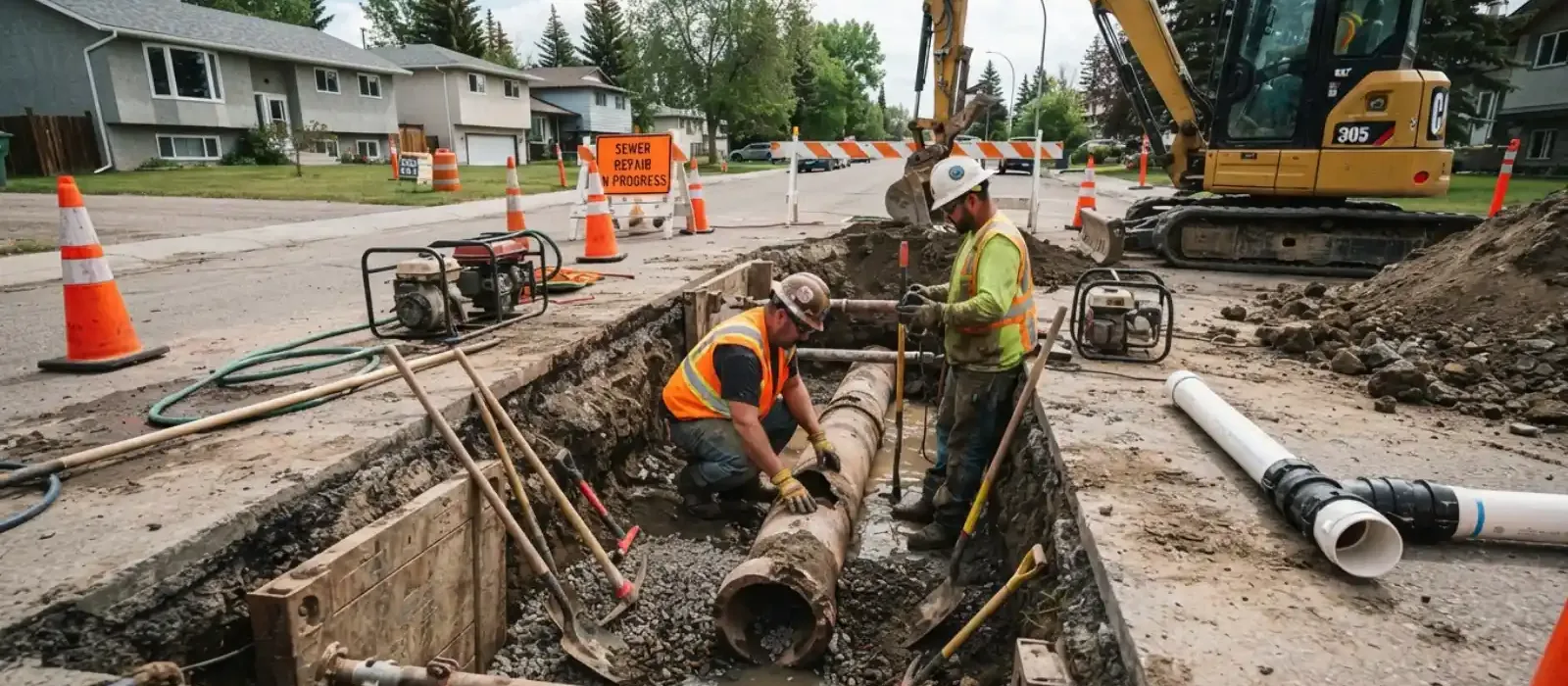
Signs the sewer line itself is failing, not just clogged
Backups that return after cleaning
A clean line stays clean for a long time. A line that clogs again within weeks has a defect holding debris.
Soft, sunken or lush patches in the yard
A broken pipe leaks wastewater into the soil. The ground above it may sink or grow greener than the rest of the lawn.
Sewer odor outdoors or in the basement
Gas escapes through a crack. A smell near the foundation with no clog is worth a camera visit.
Gurgling and slow drains in every fixture
Water cannot get past a sag or a collapse, so air pushes back through traps.
Sewer backup now: how the first hour should go
While you wait for the plumber
Dispatch answers 24/7 and books a same-day visit when a crew is free. These steps limit the damage until then.
- Stop using water. Every flush goes to a line that cannot take it.
- Find the lowest drain. Backups rise there first, so move belongings off that floor.
- Do not cable a broken pipe. A cable can snag on a crack and make it worse, so wait for a camera look.
- Photograph everything. Date and water level help with a claim.
- Gas smell means leave. Go outside and call the gas utility or 911 before you call a plumber.
How the plumber finds the break
Camera through the cleanout
A sewer camera on a push cable shows cracks, offsets, sags and root masses on video.
Locate the depth and spot
A locator tracks the camera head from above ground, so the plumber marks the exact spot and depth.
Call 811 before any digging
Connecticut asks for notice at least two full business days before mechanized digging, which gives utilities time to mark their lines.
Choose spot repair, lining or replacement
The video decides. A short broken section differs from a line that is failing along its length.
Think the line is broken?
Tell dispatch what you see in the yard and in the drains. A same-day camera visit is available when a crew is free, at any hour.
Dig, line or replace: a decision table
| Option | Best for | Trade-off |
|---|---|---|
| Spot repair by excavation | One short broken section with good pipe on both sides | Digs a trench and restores the yard |
| Pipe lining (trenchless) | Cracks and joint leaks in a pipe that still holds its shape | Needs a clean pipe first, and it is not a fit for a collapse or a bad sag |
| Full replacement | Pipe that is failing along its length or has collapsed | Biggest job, with permits and inspections |
| Cleaning only | A clogged but sound line | Does nothing for a crack, so see sewer line cleaning first |
Cast iron sewer pipe in older Farmington homes
Census Bureau ACS estimates for 2020 to 2024 count 1,211 Farmington homes built before 1940 and 2,910 before 1960. Houses of that age often have cast iron in the drain and sewer, and cast iron rusts from the inside, scales and can crack or split at joints. A camera shows scale and thin walls, and a section of iron can be replaced with PVC without touching the sound parts.
Trenchless lining: what it fixes and what it does not
Pipe lining pulls a resin-soaked liner through the old pipe and cures it into a new inner pipe, so the yard stays intact. It works when the pipe is round, continuous and mostly clean. A heavy sag, a collapse or an offset joint may rule it out, and permit rules vary, so ask the town building department. A sewer inspection before the decision avoids surprises.
Septic or town sewer: what Farmington's code says
Farmington's Town Code Chapter 156 bars a new septic system or cesspool where public sewer is available, and an owner can be required to connect within 90 days of notice. Town minutes show the Water Pollution Control Authority approved a sewer connection for one Farmington Avenue property in 2023 because its septic could not be made code compliant. In Connecticut, local health directors permit septic systems up to 10,000 gallons per day.
Ask whether sewer is available
The Town Engineer can tell you if public sewer reaches your address. We could not find a public map of Farmington's septic areas, so ask the Town Engineer whether your street is on the sewer.
Get the permit
A permit to connect from the Town Engineer is required, and each building gets its own separate building sewer.
Use a licensed installer
The code says the installer must hold a valid Connecticut drainlayer license. Check any plumber on eLicense.
Give notice for inspection
The trench stays open until the Town Engineer inspects, with 24 hours of notice.
What drives the price of a sewer line repair
No honest number exists until a camera shows the pipe, and these factors explain why.