
Why a fair price needs a site visit
Two houses on the same street can need very different work. One has a damp corner caused by a downspout dumping at the foundation. The other has a seeping wall below the water table. A quote that arrives over the phone without a look at either one is a guess.
Expect any serious contractor to walk the outside, check gutters and grading, and inspect the basement wall and floor before writing a scope. The price follows that scope.
Cheaper fixes come first
Many wet basements improve after you extend downspouts, clean gutters and regrade soil so it slopes away from the house. Try those before you approve excavation. If the water keeps returning after the roof water is under control, exterior or interior drainage is the next step.
The cost drivers behind every quote
| Factor | What it means on site | How it affects the quote |
|---|---|---|
| Length of wall | Only the leaking side, or the full perimeter | More linear feet means more digging, membrane and drain tile. |
| Depth to the footing | A deep basement needs a deeper trench | Deeper trenches need more labor, shoring and soil hauling. |
| Access | Decks, porches, patios, trees, utilities and tight side yards | Anything that must be removed or worked around adds hours and restoration. |
| Drainage design | Drain tile, gravel, a sump pit and a discharge route | A system that needs a pump and a long discharge run costs more than gravity drainage. |
| Wall condition | Cracks, block versus poured concrete, old coatings | Repairs before sealing add steps, and block walls often need more prep. |
| Restoration | Backfill, grading, landscaping, concrete or pavers | Putting the yard back can be a large part of the total. |
Ask for the scope in writing, line by line, so you can compare two bids on the same basis. A low bid that skips the sump pit, the restoration or the wall repair is not low at all.
Exterior or interior: what you are buying
Exterior waterproofing
- Excavates to the footing and seals the wall from outside
- Adds drain tile and gravel to carry water away
- Stops water before it reaches the wall
- Disturbs the yard, and decks or patios may need to come out
Interior drainage
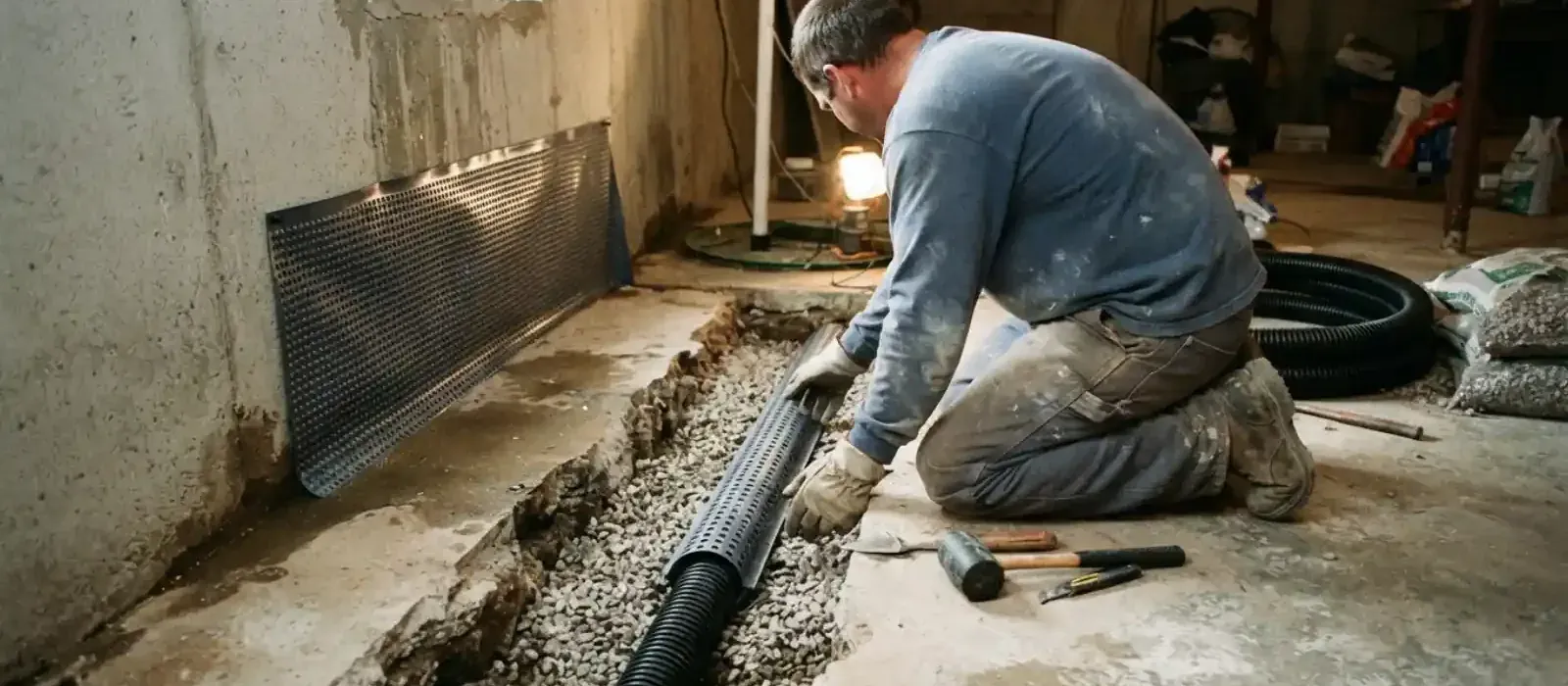
- Cuts a channel along the inside of the floor
- Collects water that enters and sends it to a sump pit
- Works without digging up landscaping
- Manages water that reaches the wall, rather than blocking it
Exterior work suits a wall that leaks in a defined area and where the yard is open. Interior systems suit finished yards, tight lots and floors that seep along the joint. Many houses end up with a mix, and a pump is part of either design. Our basement waterproofing page explains how crews decide between them.
Want the scope written before you compare bids?
A licensed plumber can inspect the sump, the discharge line and the floor drains, and explain what the drainage side of the job needs. Call (860) 397-8103 for a clear price before work starts.
What Farmington's flood record means for your basement
Farmington's hazard mitigation plan lists the Farmington and Pequabuck Rivers, plus Great, Hyde and Scott Swamp Brooks, as the town's main watercourses. It says Meadow Road floods every year and notes that a culvert on Dorset Lane was upsized from 18 to 42 inches. It also says newer FEMA mapping added some properties to the flood zone.
For you, that splits the question in two. Groundwater and roof runoff seeping through a wall are what waterproofing treats. River or brook overflow is a flood, and a membrane does not stop a flooded yard.
History shows the scale. The Unionville Museum records that the August 1955 flood put the river about 10 feet above the road, with River Glen the worst-hit part of Unionville. If your lot is near any mapped waterway, ask the contractor whether the work addresses seepage only, and keep a working sump pump with a battery backup in the plan.
Know what insurance does and does not cover
The Connecticut Insurance Department says standard homeowners policies do not cover flood damage. Water from internal sources such as burst pipes is generally handled under homeowners insurance.
- Waterproofing itself: treat it as home maintenance, because policies rarely pay for prevention.
- Sewer backup: the state notes it is typically not part of standard flood insurance and may need separate coverage.
- Flood policies: most carry a 30-day waiting period, so buying one during a storm is too late.
Where foundation water can and cannot go in Farmington
Farmington's Town Code, Chapter 156, says stormwater, roof drains and foundation drains may not connect to the sanitary sewer. A new interior drain or sump discharge has to go somewhere else, so ask any contractor exactly where your pump line will end. The code text on the town's code site may predate amendments, so confirm with the Town Engineer.
Digging also has a rule. Connecticut law requires a call to 811 or CBYD.com at least two full business days before mechanized digging, and the call is free. A contractor should make it, and you should ask to see the ticket number.
Source type: municipal code and state call-before-you-dig guidance
Questions to ask every contractor
Who is licensed for what?
Ask for the contractor's Connecticut home improvement registration and check it on eLicense. Any plumbing in the scope, such as a sump discharge line, calls for a state plumbing license, so look up the P-1 or P-2 holder.
Where does the water go?
Get the discharge route in writing. It must avoid the sanitary sewer and should not create a new problem on the neighbor's lot.
What happens to the yard?
Ask who restores soil, plantings, walkways and any deck footings, and whether that cost sits inside the quote or outside it.
Is there a permit?
Permit rules vary, so ask the town building department which parts of the scope need one and who will apply.
How is the work backed up?
Ask what the written warranty covers and whether it transfers if you sell. Connecticut Department of Consumer Protection guidance says most jobs over $200 need a written contract.
A look across the town line
Floodplain rules change from town to town. In Avon, the regional hazard plan says the town regulates both the 1 percent and 0.2 percent annual-chance floodplains, with new development set above known flood levels, so a lot near the Farmington River faces extra review. In Newington, MDC says downspouts, sump pumps and yard drains tied to old sewer connections can feed basement backups, which makes the discharge route as important as the drain itself.