
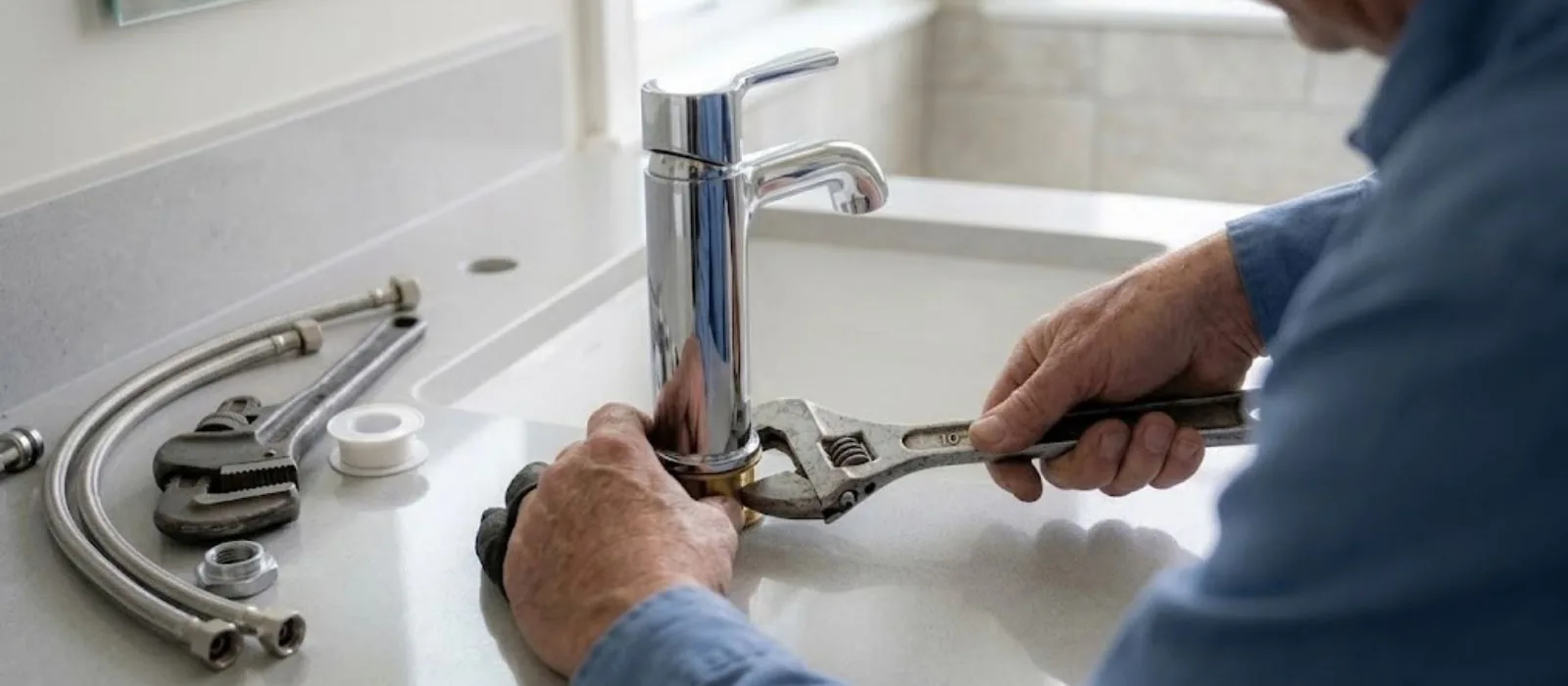
A valve will not close and water keeps flowing
This is the version of the problem that cannot wait. A supply valve that spins without stopping the water, a handle that snapped off in your hand or a line that let go under the sink all point to the same first move, the main valve.
Find the main
Look near the water meter or where the line enters the house. The main shutoff is often near the water heater or where the line enters the house. Turn it clockwise until the flow stops.
Open the lowest tap
Run a basement or outdoor spigot to drain the pipes and drop the pressure. That slows any remaining leak.
Contain the water
Set a bucket or pan under the drip, pull stored items out of the vanity and lay towels. Avoid wet outlets and power strips nearby.
Photograph and call
Take a quick photo of the fixture and the damage for your records, then call the line. Dispatch is open nights and weekends and books same-day visits when a crew is free.
Reading the drip: what each symptom usually means
| What you see | Likely cause | Usual fix |
|---|---|---|
| Steady drip from the spout | Worn cartridge, washer or seat | Replace the cartridge or washer, clean the seat |
| Handle stiff or leaking at the base | Dry or cut O-rings, loose packing | New O-rings and fresh packing |
| Low flow from one tap only | Clogged aerator or debris in the cartridge | Clean the aerator, flush the cartridge |
| Water pooling in the cabinet | Corroded supply line or loose compression nut | New braided supply line, reseat the nut |
| Shower runs hot and cold, or drips after shutoff | Failed shower cartridge or valve | Replace the cartridge or the valve body |
| Shutoff valve spins but flow continues | Stripped stem or rotted washer inside | Replace the shutoff valve, which may need the main closed |
| Tub spout drips onto the floor | Diverter or spout seal failure | New spout or diverter, check the valve behind it |
Most single-handle faucets run on a cartridge, and swapping one often fixes the drip in one visit. Older two-handle faucets use washers and seats that wear differently. See burst pipe repair if the leak is inside a wall instead of at a fixture.
Kitchen, bath, tub and shower: where the repair differs
Kitchen faucet
A pull-down hose, a loose spout base or a clogged aerator is common. Kitchen faucets see daily use, so cartridges wear first here.
Bathroom sink
Pop-up drain linkages and small supply lines leak quietly. Check the cabinet floor for dampness before you decide it is only the faucet.
Tub faucet and spout
A dripping tub spout wastes more water than it seems. The fault is often in the valve behind the wall, which means opening the access panel.
Shower valve
A shower that fluctuates in temperature or leaks behind the trim usually needs a cartridge. If the valve body is corroded, the repair is bigger.
Slow shower and tub drain
A hair-clogged drain can pose as a faucet problem when the water pools. A drain cable clears it, see drain cleaning.
Who may legally fix your faucet
Connecticut's 2022 State Building Code adopts the 2021 International Plumbing Code (IPC), and fixture work falls under it. The Connecticut Department of Consumer Protection says plumbing work needs its own current state professional license, so check any plumber on the state's eLicense lookup before you let them open a wall or replace a shutoff valve.
Faucet leaking and the shutoff will not hold?
Call the 24/7 line, tell dispatch which fixture it is and hear a clear price before work starts. Same-day appointments are offered when a crew is free.
Lead, brass and what Farmington's water reports say
Choosing a replacement faucet
Connecticut Water's 2025 report for the Unionville system, which serves parts of Farmington, lists a lead 90th percentile of 2.0 parts per billion against a 15 ppb action level. The same report notes that corrosion of household plumbing is the typical source of lead and copper, and faucets and fittings are part of that plumbing.
The state Department of Public Health notes that brass sold as lead-free may still contain up to 8 percent lead. If a tap has sat unused for more than six hours, flush it until the water turns colder before you drink it.
Farmington is served by more than one water system, so your own bill shows which one supplies your home. Ask your utility for its annual water quality report if you want to know more about what runs through your faucets.
Repair the old faucet or put in a new one
Repair when
- The faucet body is sound and only the cartridge, washer or O-ring has worn
- Parts are available for the model and the finish is intact
- The leak is at the supply line or shutoff valve, not the faucet
- You like the faucet and nothing else has failed
Replace when
- The body is pitted, cracked or leaking from a seam
- Parts are discontinued or cost close to a new faucet
- Mineral crust or corrosion has frozen the handle or stem
- You are changing the sink, counter or fixture style anyway
A repair that needs the shutoff replaced is the one that surprises people. If the old valve will not close, a plumber closes the main, swaps the valve and then fixes the faucet, which turns a small repair into a short plumbing job.
How a faucet repair is priced
Price follows what has failed and how hard it is to reach. A cartridge swap on an accessible kitchen faucet is a short visit. A shower valve behind tile is not.
Call (860) 397-8103 for your number, and a clear price comes before the work starts.