
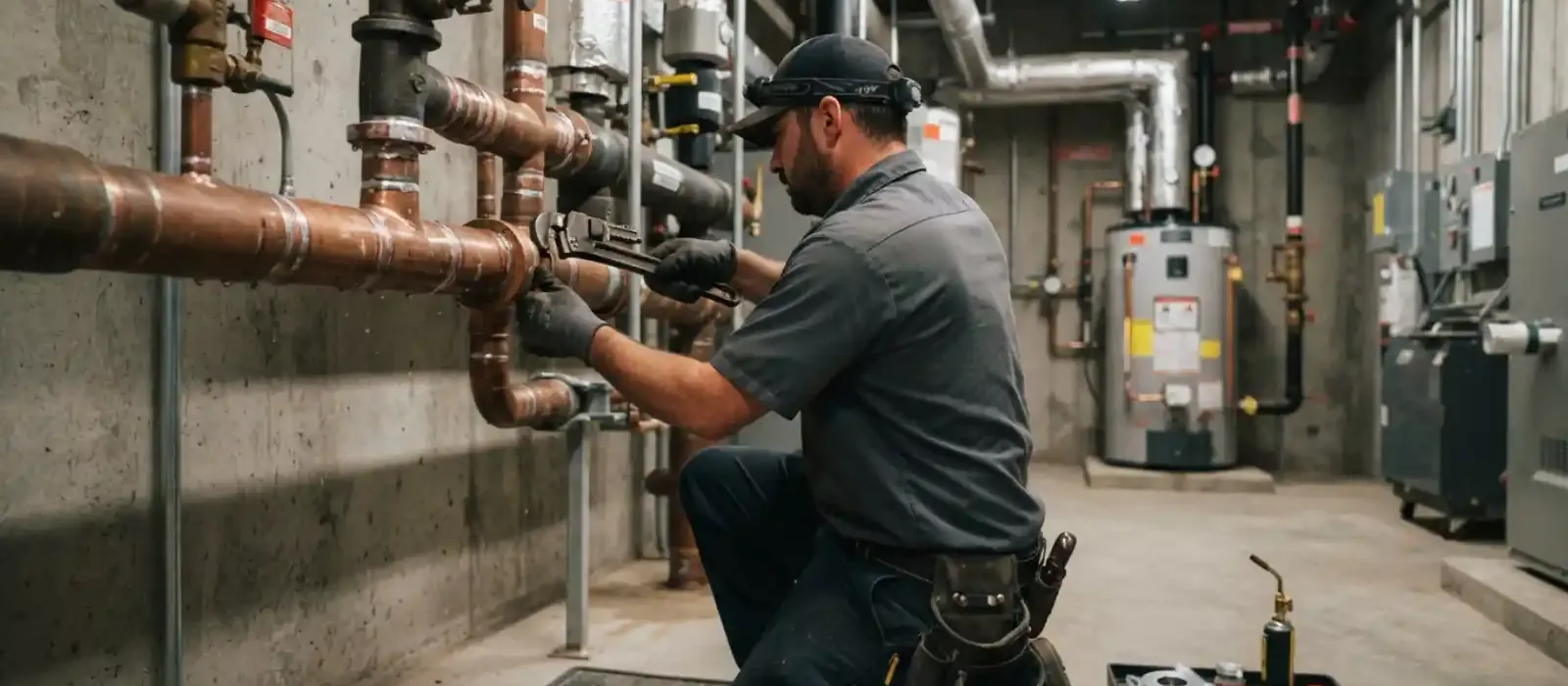
A failure after hours: what to do before the plumber arrives
Business checklist while you wait
Protect people and property first, and the plumbing second.
- Find the main shutoff. Know where the water enters the building and close it if the leak is spreading. Label it for staff.
- Stop using affected fixtures. Tape off restrooms or sinks that are backing up or leaking.
- Cut power to wet areas. If water reaches outlets, cabinets or equipment, shut the circuit off from a dry spot.
- Protect stock and records. Lift boxes, paper and electronics off the floor.
- Note who owns what. If you lease, tell your landlord or property manager. The lease decides who pays and who calls.
Our line runs 24/7, so a backup at 10 p.m. after a dinner service gets the same answer as a leak at 9 a.m. Same-day visits are booked when a crew is free, and dispatch gives you a clear price before work starts.
What Farmington businesses call about
Restroom backups and overflows
A clogged toilet or floor drain in a public restroom shuts a business down. A cable or camera finds the cause fast.
Kitchen and grease line stoppages
Restaurants and cafes fight grease buildup in sinks and floor drains. Grease traps need scheduled cleaning, and a full trap sends waste back into the kitchen.
Water heater and hot water failures
A commercial water heater that quits closes a kitchen or a salon. See water heater repair for tank and fuel details.
Hidden or recurring leaks
A bill that jumps, a stained ceiling tile or a damp wall in an occupied building points to a leak that may take tracing.
Backflow device testing
Many commercial buildings carry backflow preventers that need annual testing by a qualified tester.
Along US 6, Farmington Avenue and Unionville
Businesses in Farmington range from the Scott Swamp Road corridor and Farmington Avenue to the old mill village of Unionville and the Westfarms area on the Farmington and West Hartford line. The town's top employers listed in its 2024 report include UConn Health, Otis Worldwide, Companions and Homemakers and Trumpf.
Building age and use vary widely, so the plumbing does too. A mill-era building in Unionville is likely to have different piping from a newer strip center. A plumber looks at what is behind your walls before proposing a repair.
Tenant fit-outs and permits
The town's permit list includes a category for WestFarms Mall tenant fit-outs, so ask the building department how a tenant build-out at a mall or plaza is permitted. Permit rules vary, so ask the Farmington building department before you move a sink, add a floor drain or relocate a restroom.
Backflow rules for businesses
Connecticut's Public Health Code section 19-13-B38a requires an air gap between potable water lines and equipment that may be subject to contamination, and it puts the cost of buying, installing and maintaining required devices on the owner. If your shop has a dishwasher, mop sink hose or irrigation tie-in, ask a licensed plumber which protection applies. Commercial repairs also follow the 2021 International Plumbing Code (IPC) adopted through the 2022 Connecticut State Building Code.
Plumbing problem in your shop, office or restaurant?
Call the 24/7 line, tell dispatch what is happening and hear a clear price before work starts.
Who decides what: owner, tenant and plumber
| Situation | Likely cause | First step |
|---|---|---|
| Restroom toilet overflowing | Fixture clog or main line | Close the stop valve, see toilet repair for fixture issues |
| Kitchen floor drain backing up | Grease or solids in the branch line | Stop dishwashing, call for a cable or jetting |
| Several fixtures slow at once | Main line blockage | Stop using water, schedule a camera check |
| Wet ceiling tiles | Supply or drain leak above | Close the main if active, call for tracing |
| Hot water gone in a kitchen | Heater or gas issue | Check the pilot or power, call if it does not relight |
| Backflow device failed its test | Worn parts | Repair or replace and retest with the water system |
Most commercial leases split responsibility between landlord and tenant. Read yours before you hire, because a landlord may require their own plumber or the repair may be theirs to pay.
Drains, grease and storm water
Kitchen lines and grease traps
A grease trap catches fats before they enter the sewer. It must be pumped and cleaned on a regular schedule, or it overflows into the kitchen. A trap that smells, drains slowly or shows grease at the outlet is overdue.
Hydro jetting clears grease buildup from pipes more thoroughly than a cable alone. See hydro jetting for how it works. Farmington's town code does not allow stormwater, roof or foundation drains to connect to the sanitary sewer, so keep downspouts separate.
Backflow, restroom fixtures and the state rules
Connecticut's Public Health Code requires an air gap between potable water lines and equipment that may be contaminated, and it requires a vacuum breaker or air gap on flush valve toilets. Owners must buy, install and maintain required devices, and testing devices such as reduced pressure and double check assemblies is done annually through the water system's program.
A water company may not give new service to a site with a prohibited connection. If you are opening a restaurant, salon or clinic, ask your plumber about the backflow requirements before inspection.
Leak detection in an occupied building is modest work. A plumber uses moisture meters, a thermal camera and sometimes acoustic listening to narrow where the water is. The goal is to trace the line, not open the whole wall. See leak detection for the methods.
What shapes a commercial plumbing quote
A commercial job can be a one-hour drain clearing or a multi-day repair. Scope sets the number.
Call (860) 397-8103 for your number, and a clear price comes before work starts.