
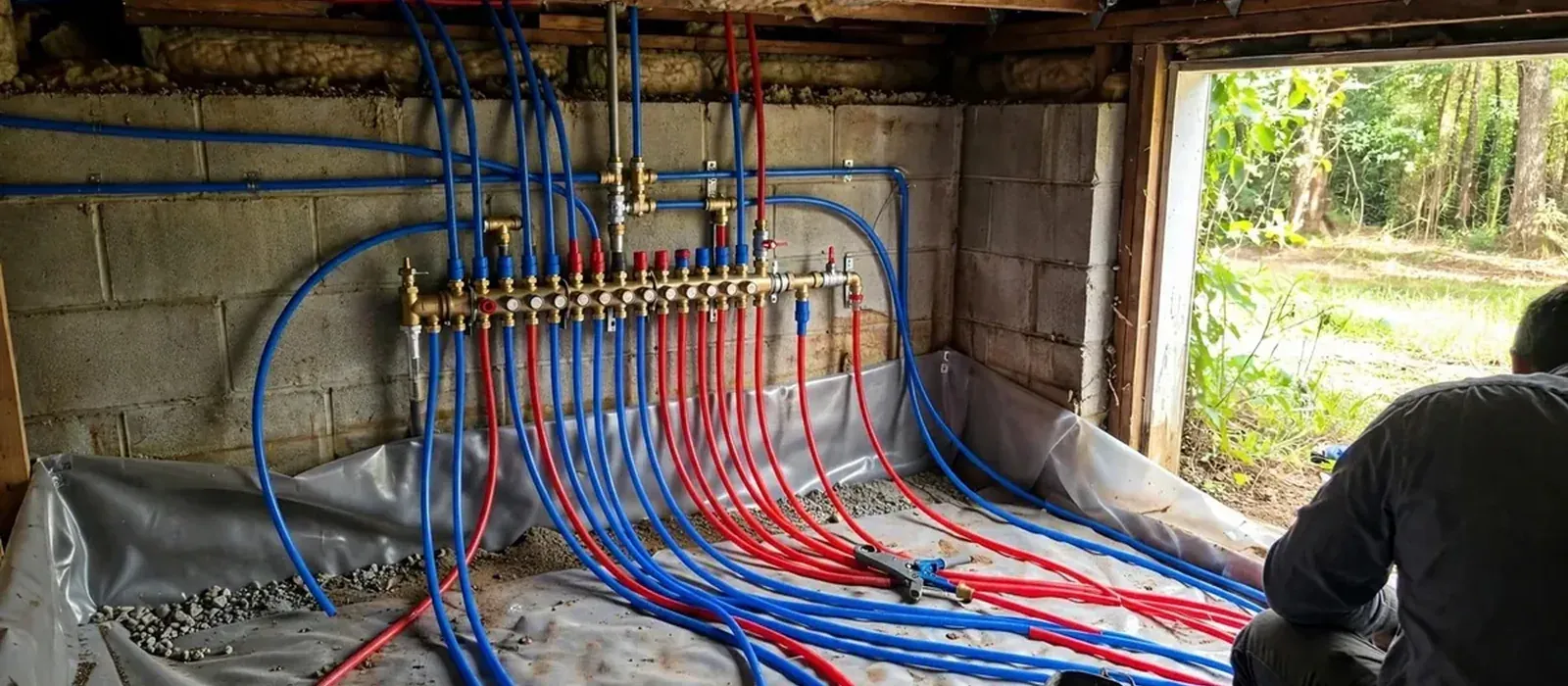
The repipe from first visit to final test
Inspect and map the system
The plumber traces every supply line, checks the shutoff valves, looks at the pipe material in the basement or crawlspace and notes which walls hold the pipes.
Agree on a plan and a price
You get a written scope that lists the fixtures, the pipe type, the planned wall openings and who patches them. A clear price comes before work starts.
Pull the permit
Permit rules for replacing piping vary by town and by job. Confirm with the town building official before work starts, because your plumber needs to know what the inspector expects.
Open the walls and run new lines
Old pipes are cut out or abandoned in place. New lines are fished through walls, floors and the basement ceiling, then connected to each fixture.
Pressure test and inspect
The system is filled and held under pressure to confirm no joint leaks. The town inspector looks at the work before walls are closed.
Close up and flush
Patching is done or handed to a drywall contractor, depending on your agreement. Faucet screens are cleaned, and the lines are flushed.
Most of the time on site goes to access, not pipe. A cleanly planned job leaves a handful of openings in closets, behind vanities and in basement ceilings. Our repiping page covers the signs that point to replacement, such as brown water, low pressure and repeated pinhole leaks.
PEX or copper: choosing the new pipe
PEX tubing
- Flexible plastic that bends around corners with fewer joints
- Easier to thread through finished walls, so fewer openings
- Does not corrode or form pinholes from the inside
- Must be kept out of sunlight and away from certain chemicals
Copper pipe
- Rigid metal with a long track record in older homes
- Soldered joints take more skilled labor and more time
- Can pit or develop pinholes if the water chemistry attacks it
- Holds up in exposed runs such as an unfinished basement
Neither is wrong. PEX is the common pick when the goal is fewer wall openings and a shorter job. Copper makes sense for visible basement mains or when the owner wants a metal system. A plumber who explains both, instead of pushing one, is working for you.
How much of your wall gets opened
Plaster-and-lath walls in a 1930s house behave differently from drywall in a 1990s one. Plaster cracks and sheds dust, so plumbers tend to open larger, neater sections and patch them with drywall or a skim coat. Drywall homes usually take smaller cut-outs, often a hole about the size of a cabinet door at each fixture group.
Ask where the cuts will go, who patches them and who paints. Patching and paint are often a separate trade. Put it in writing, so the bill has no surprise line at the end.
What drives the cost of a repipe
| Factor | What to look at | Effect on the job |
|---|---|---|
| House size and bathrooms | Number of stories, baths, kitchens and laundry hookups | More fixtures mean more pipe, more openings and more days |
| Pipe material | PEX or copper | Copper costs more in material and labor, PEX is quicker to run |
| Wall and ceiling type | Plaster, drywall, finished basement or open joists | Finished surfaces cost more to open and repair |
| Fixture and valve work | New shutoffs, a new main valve or manifold | Replacing old valves while the walls are open is cheaper than doing it later |
| Permits and inspection | Town permit, inspection visit | Fees are set by each town. Ask your building department |
| Patching and paint | Included or by another trade | This is the line item most often left off a quote |
Standards for new piping
New piping has to meet the 2021 International Plumbing Code (IPC) as adopted through the 2022 Connecticut State Building Code. Ask the Farmington Building Department at 860-675-2315 whether your job needs a permit.
Planning a repipe?
Tell us the age of the house, how many bathrooms it has and what the wall surfaces are. We explain the options and state a clear price before work starts.
Housing eras and the repipe question
Farmington has about 11,800 housing units, and the Census Bureau's 2020 to 2024 estimates put the median year built at 1980. Roughly 2,900 homes (about 25 percent) predate 1960, and about the same share date from the 1960s and 1970s. The rest, around half, were built from 1980 on.
| Built | Farmington homes (ACS 2020 to 2024) | What to check |
|---|---|---|
| 1939 or earlier | About 1,200 | Galvanized steel supply, plaster walls, original valves |
| 1940 to 1959 | About 1,700 | Galvanized or copper, old shutoffs, mixed repairs over the years |
| 1960 to 1979 | About 2,900 | Copper with aging joints and valves, original fixtures |
| 1980 and later | About 6,000 | Usually copper or plastic. Repipe is rare, a leak is more likely a joint or fitting |
Galvanized steel is the usual repipe candidate, because it rusts from the inside out and narrows over decades. If your faucets run brown or pressure has dropped across the whole house, that points to the supply lines. If one pipe leaks, a spot repair may do. A leak between the street and the house is a different job, covered under water line repair.
Farmington water systems and what the lead and copper results say
Farmington is served by more than one water system. Connecticut Water's Unionville and Avon systems serve parts of town, and the Chimney Hill system buys its water from the Metropolitan District Commission. Your bill shows which system is yours. In its 2025 report, the Unionville system listed a copper result of 0.807 ppm at the 90th percentile against an action level of 1.3, and lead at 2.0 ppb against an action level of 15.
The report names corrosion of household plumbing as the usual source of both metals. That makes the repipe conversation a good time to also look up your service line material: Connecticut Water publishes a service-line inventory you can search by address. Ask your utility where its responsibility ends, because that decides which pipes the repipe covers. The pipe after that is your repipe.
Source type: utility water-quality report and service-line inventory
Repiping in West Hartford and Avon
West Hartford housing is older than Farmington's. The Census shows a median build year of 1954, and about 65 percent of its 27,000 housing units predate 1960. In the West Hartford area, that points to older supply lines and shutoff valves more often than in Farmington. The town building department runs permits through its online CityView portal and says it is the homeowner's job to confirm that a contractor has them.
Avon is the other direction: about 85 percent of homes are owner-occupied, and the town's permit page says nothing on plumbing, so call the building department at 860-409-4300 before work starts. Repiping planning is the same whether you are in Avon or Farmington.
How long it takes and what living there is like
For an average single-family house, plan on a few working days. A small ranch with one bath can go faster, and a large older home with plaster walls can take longer. Water is off for part of each day, and the plumber usually restores a bathroom or kitchen line at night so you can cook and wash.
Plan for dust, noise and furniture moved away from walls. If a family member is sensitive to dust or noise, ask about an off-site stay for the loudest day.
Questions to ask before you sign
A short checklist for any repiping quote
- License: check the plumber on Connecticut eLicense (elicense.ct.gov), run by the Department of Consumer Protection
- Permit: who applies and who pays for it
- Material: PEX or copper, and why
- Patching: who closes walls and paints them
- Warranty: what the labor and material coverage is, in writing