
Brown water, weak showers and pinholes: when patching stops working
One leak is a repair. A second leak on the same line a few months later, then a third, is a pattern. That is what a failing pipe system looks like, and it is usually when homeowners start asking about repiping.
Other signs include rust-tinted water that clears after running, pressure that has faded over the years and stains on ceilings below bathrooms. If the problem is one fixture, repiping is not the answer. If it is everywhere, it may be.
Repeated pinhole leaks
Small leaks keep appearing along the same run. Each patch holds until the next weak spot gives way.
Discolored water
Orange or brown water from several taps suggests rust inside steel pipe.
Falling pressure
Buildup narrows older steel pipe from inside, so flow drops even though the main valve is fully open.
A pipe you can see is rusty
Rust bloom, flaking and green or white crust at joints show where corrosion has taken hold.
Farmington homes by age, and what may be inside the walls
Census Bureau estimates for 2020 to 2024 count 1,211 Farmington homes built in 1939 or earlier, 392 from the 1940s and 1,307 from the 1950s. That is 2,910 units before 1960, about a quarter of the town's 11,837. Another 2,919 date from 1960 to 1979, and 6,008 from 1980 on.
| Built | Units in town | What to ask a plumber |
|---|---|---|
| 1939 or earlier | 1,211 | Is any galvanized steel left, and have fittings been updated over time? |
| 1940 to 1959 | 1,699 | Is the original supply still in place, and what condition are the joints? |
| 1960 to 1979 | 2,919 | Which sections were replaced, and is the copper or older piping showing wear? |
| 1980 and later | 6,008 | Is there PEX or copper, and are problems at fixtures rather than the pipe itself? |
The table describes the town, not your house. A plumber confirms the material by looking at exposed pipe in the basement or utility room and testing a few spots. A newer house is not automatically problem-free, and an older one may have been repiped already.
Repipe or keep repairing?
Repair is enough when
- One leak sits at a fitting or valve
- The rest of the run is sound when inspected
- Pressure and water color are normal
Repiping makes sense when
- Pinholes or splits show up in more than one place
- Steel pipe is clearly corroded or restricting flow
- Walls are already open for a remodel
A full repipe disrupts a house for a few days, but new lines tend to avoid the cycle of one repair after another. A partial repipe, such as one bathroom group or a basement run, is often an option. Ask the plumber to price both and explain what each leaves behind. To track down an unseen leak first, see leak detection.
PEX or copper: how to choose
| Question | PEX | Copper |
|---|---|---|
| Installation | Flexible tubing that snakes through walls, often with fewer cuts and joints | Rigid pipe soldered or fitted at each joint, slower to route |
| Wall damage | Usually less drywall opened | May need more access |
| Freeze behavior | Tolerates some expansion | Can split when frozen |
| Sun and chemicals | Must stay out of sunlight and away from some solvents | Not bothered by sunlight |
| Longevity record | Newer, with a shorter track record | Decades of use in homes |
Neither is right for every house. PEX often wins on speed and wall impact. Copper wins when you want a long history or an exposed run that must look neat. A plumber who explains both, and the local code, is worth more than one with a favorite.
How a repipe happens, start to finish
Inspect and plan
The plumber traces the supply, checks pressure and decides which sections to replace.
Permit and schedule
Connecticut's code says an owner or agent replacing a regulated plumbing system must first apply to the building official. Permit rules vary, so ask the town building department.
Shut off and open access
Water is shut off for the work, and small openings are made in drywall at key points.
Run the new lines
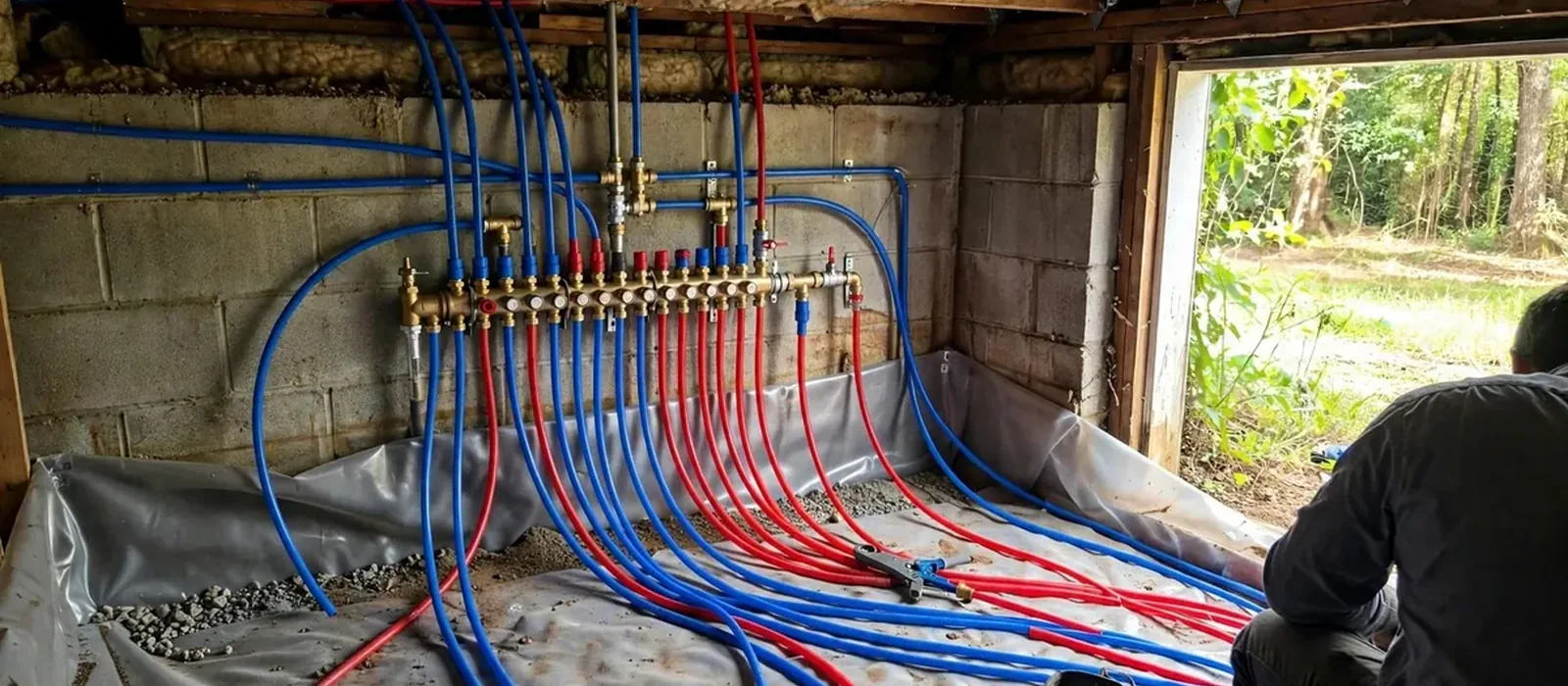
New pipe is run to fixtures, joined at manifolds and supports are placed.
Pressure test and restore
The system is tested before it is closed up. Drywall patching is often a separate trade.
Standards for new piping
New supply and drain piping must meet the 2021 International Plumbing Code (IPC) as adopted through the 2022 Connecticut State Building Code. Ask your town building department whether the job needs a permit, and confirm your plumber holds a current Connecticut license on eLicense before work begins.
Thinking about a repipe?
Describe the pipe material, the age of the house and what you are seeing, and the 24/7 line will book a same-day visit when a crew is free.
Water quality, lead and what repiping does not change
Repiping replaces the pipes inside your house. It does not change the water coming from the street, or the service line. Connecticut Water's Unionville, Avon and Chimney Hill systems all serve parts of Farmington, and your bill shows which one is yours. For the buried part, read water line repair.
The 2025 Unionville report lists copper at 0.807 ppm at the 90th percentile against a 1.3 ppm action level. DPH says boiling does not reduce lead and that lead-free brass may still contain up to 8 percent lead, so ask your utility for its report and test your tap.
Before you sign a repipe quote
- Verify the license. Look the plumber up on Connecticut eLicense, run by the Department of Consumer Protection.
- Get the scope in writing. Which fixtures, which shutoffs, which materials and who patches drywall.
- Ask about warranty terms. Get both pipe and workmanship coverage described in the contract.
- Ask about the water heater connection. Old fittings often get replaced during a repipe.
What changes the cost of repiping
Cost factors
No two houses are the same, so a clear price comes from looking, not from a formula.