
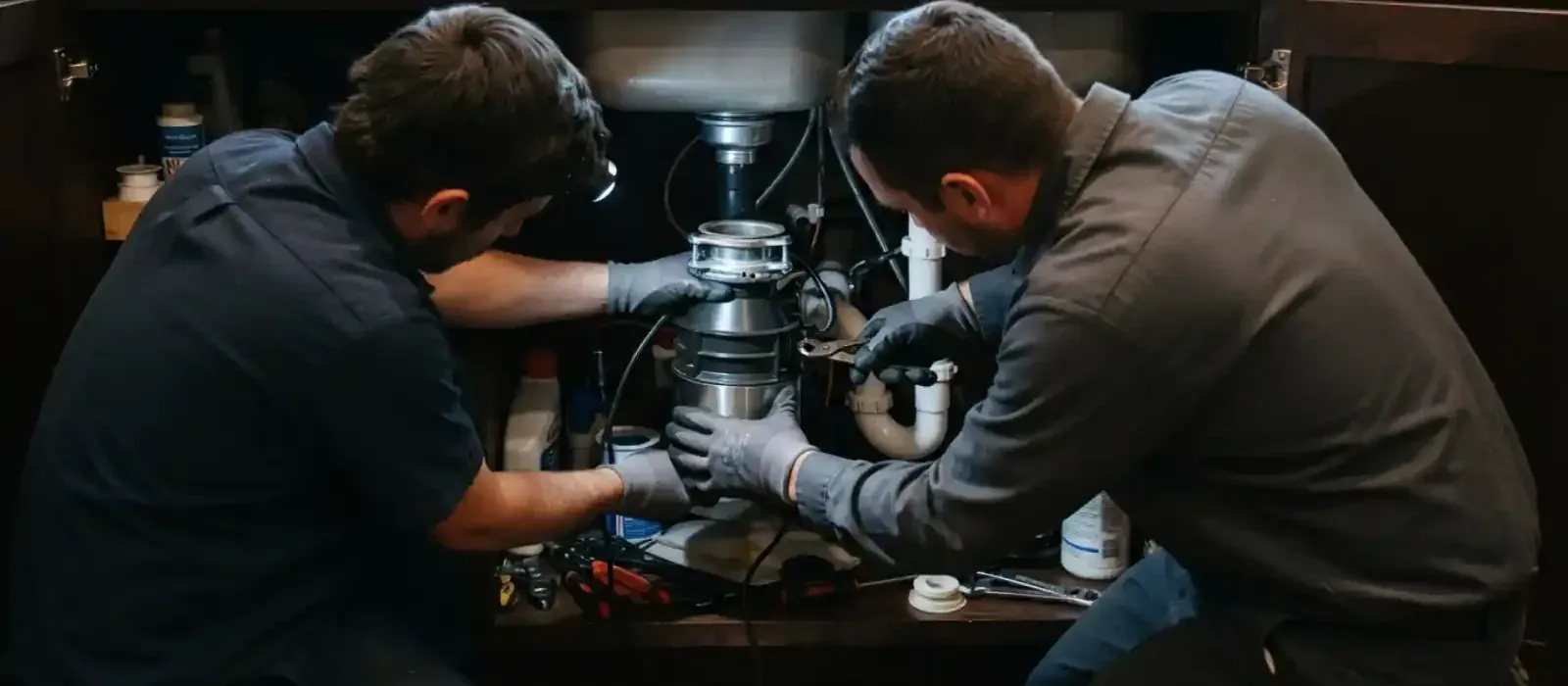
Replacement or first-time install: two different jobs
Replacing an existing disposal
- Power and drain connections are already in place
- Most brands use a mounting ring that fits the same sink opening
- Typical work: unplug, release the old unit, hang the new one, reconnect
- Most common reason to bring in a pro: a seized flange or a leaking sink seal
Installing where there was none
- Needs a power source, usually a switched outlet under the sink
- The drain trap must be rebuilt to take the disposal's outlet
- The sink needs a standard 3 1/2 inch drain opening
- Often involves an electrician and a plumber working together
If the old unit is a different horsepower or brand, expect small differences in the mounting hardware and outlet height. Common household sizes run from about one third to three quarters horsepower. A bigger motor clears tougher scraps but costs more and needs more room below the sink.
The electrical side
Disposals run on household current, and there are two common setups. A plug-in model connects to an outlet under the sink, and the outlet is usually controlled by a wall switch. A hardwired model connects directly to a cable from a junction box and a switch.
If your sink has no existing outlet or switch, adding one means new wiring. That is electrician's work, and the permit rules for it vary by town, so ask the building department before you start. Always shut off the breaker and confirm with a tester before touching any wire.
The dishwasher knockout, step by step
Many disposals have a small inlet on the side for the dishwasher drain hose. Out of the box that inlet is blocked by a plastic plug called the knockout. If you connect a dishwasher and forget to remove it, the dishwasher cannot drain, and you will find dirty water sitting in the bottom of the machine.
Decide if you need it
If a dishwasher drains through this sink, the knockout must come out. If not, leave it in place.
Do it before mounting
Remove the plug while the unit is still on the bench, so you can reach the inside.
Tap it out
Set a screwdriver against the plug and tap it with a hammer until it drops into the grinding chamber.
Fish out the plug
Reach in with pliers and take it out. A left-behind plug can jam the unit or clog the drain.
Connect the hose
Clamp the dishwasher drain hose to the inlet and route it so it loops up before it reaches the disposal.
Drain connections and leak checks
The discharge pipe from the disposal connects to a P-trap, and the trap joins the wall drain. If you are replacing a unit, the old connections often line up. For a new install the trap arm may need cutting and refitting, and a second sink bowl needs a continuous waste tube to join its drain to the disposal outlet.
After you install, test it like this
- Fill the sink halfway, pull the stopper and watch every joint as it drains
- Run cold water, switch the unit on and look under the cabinet for drips
- Run the dishwasher through a drain cycle, if one is connected
- Check again the next day, because slow leaks show up on a dry paper towel
- Listen for grinding noise that could mean a utensil or the old plug is inside
Not sure which job you have?
Describe your sink and what you want. We explain the steps, whether wiring is needed and give a clear price before work starts.
Honest DIY advice
A like-for-like swap is a reasonable weekend task if you are comfortable with a screwdriver, pliers and plumber's putty. You need to turn off the power, support the heavy unit while you lock it in place and test for leaks.
| Situation | DIY reasonable? | Why |
|---|---|---|
| Same-size replacement, existing outlet | Often | Connections and mounting match what is already there |
| Mounting flange stuck or leaking from the sink | Maybe | Old putty and a frozen ring can be tough to break loose |
| New outlet or switch needed | No, call an electrician | New wiring should be done by a licensed electrician and may need a permit |
| New sink opening or rebuilt drain | Call a plumber | The trap, vent and waste arm must work together |
| Slow drain or past backups | Call a plumber | A disposal adds waste to a line that may already be restricted |
| Home on a septic system | Ask first | More ground food adds to the solids in the tank |
Connecticut requires a state license for plumbing work, issued by the Department of Consumer Protection. You can check any plumber on eLicense (elicense.ct.gov). Our garbage disposal page covers repair and replacement, and our plumbing installation page covers drains and fixture work that goes beyond a swap.
What should and should not go in
Disposals handle soft scraps well. Grease, coffee grounds in large amounts, fibrous peels and starchy foods such as pasta and rice can form a paste in the trap arm. Run cold water before, during and for about fifteen seconds after each use. Never put your hand in the chamber, even when the unit is off.
Disposals, septic tanks and Farmington's sewer system
The Town of Farmington runs a public sewer system with more than 150 miles of pipe and 17 pumping stations, and Town Code Chapter 156 makes a new septic system or cesspool unlawful where public sewer is available. Most homes on that system can add a disposal without worrying about a tank.
Some Farmington homes still use septic systems, and the Farmington Valley Health District, which serves the town, requires a permit before any part of a septic system is altered or repaired. If your house is on septic, ask a septic professional whether a disposal suits your tank before buying one. Ask the Town Engineer whether your street has public sewer.
Source type: municipal code and health district page
Permits in Bristol and West Hartford
Permit rules differ even between neighboring towns. In Bristol, the city says a permit may be required for plumbing, mechanical or electrical installation, and that any project not listed generally needs a building permit. Its published list of work that does not need a permit covers clearing stoppages and repairing leaks, but does not mention disposals, so call the Building Department at 860-584-6215. Our Bristol page has more on that city's older housing and sewer service.
West Hartford takes permit applications through an online portal. The town's building FAQ lists the 2021 International Plumbing Code among its adopted codes and says it is the homeowner's job to be sure contractors have permits. If you are in the West Hartford area, ask the building department whether a disposal swap needs a permit before you start.