
Do the meter test before you call anyone
A meter test checks whether water moves through your meter when nothing in the house should be using it. It costs nothing and gives the plumber a head start.
Shut everything off
Close all faucets, turn off the dishwasher, washer and ice maker, and make sure no one flushes a toilet.
Find the meter
It is usually in the basement near the main shutoff, or in a pit or box outside. Lift the lid if there is one.
Read the leak indicator
Most meters have a small low-flow dial or triangle. If it spins with every tap closed, water is moving somewhere.
Note the reading and wait
Write down the numbers, wait an hour with no water use and read again. A change confirms a leak.
Close the main and check again
If the meter stops when you close your main valve, the leak is inside the house. If it keeps running, the leak is between the meter and the house, or at the meter itself.
Toilets are the usual false alarm. Drop a little food coloring in each tank, wait fifteen minutes without flushing and look in the bowl. Color means a worn flapper is leaking water into the drain.
The factors that shape a detection quote
| Factor | What to expect | Why it matters |
|---|---|---|
| Where the leak is | Open pipes, finished walls, under a slab or buried in the yard | Hidden lines need more tools and more time to confirm |
| Number of methods needed | Acoustic, thermal, moisture meter, pressure test, tracer gas | Each method adds equipment and a technician's attention |
| Size and layout of the property | A small ranch versus a large multi-level home | More pipe to check means more time |
| Access to the plumbing | Clear basement or a finished one, working shutoffs | Poor access adds setup and sometimes a second trip |
| Opening up walls or ground | Small inspection holes or an excavation | Detection finds the leak. Repair is a separate scope with its own price |
| Hour of the visit | Daytime booking or an urgent night call | Ask dispatch how an after-hours visit is priced |
The key line to look for in any quote is what happens after the leak is found. Ask whether the detection fee goes toward the repair if you hire the same plumber, and whether a written report comes with it. An insurance adjuster may ask for that report.
How plumbers actually find a hidden leak
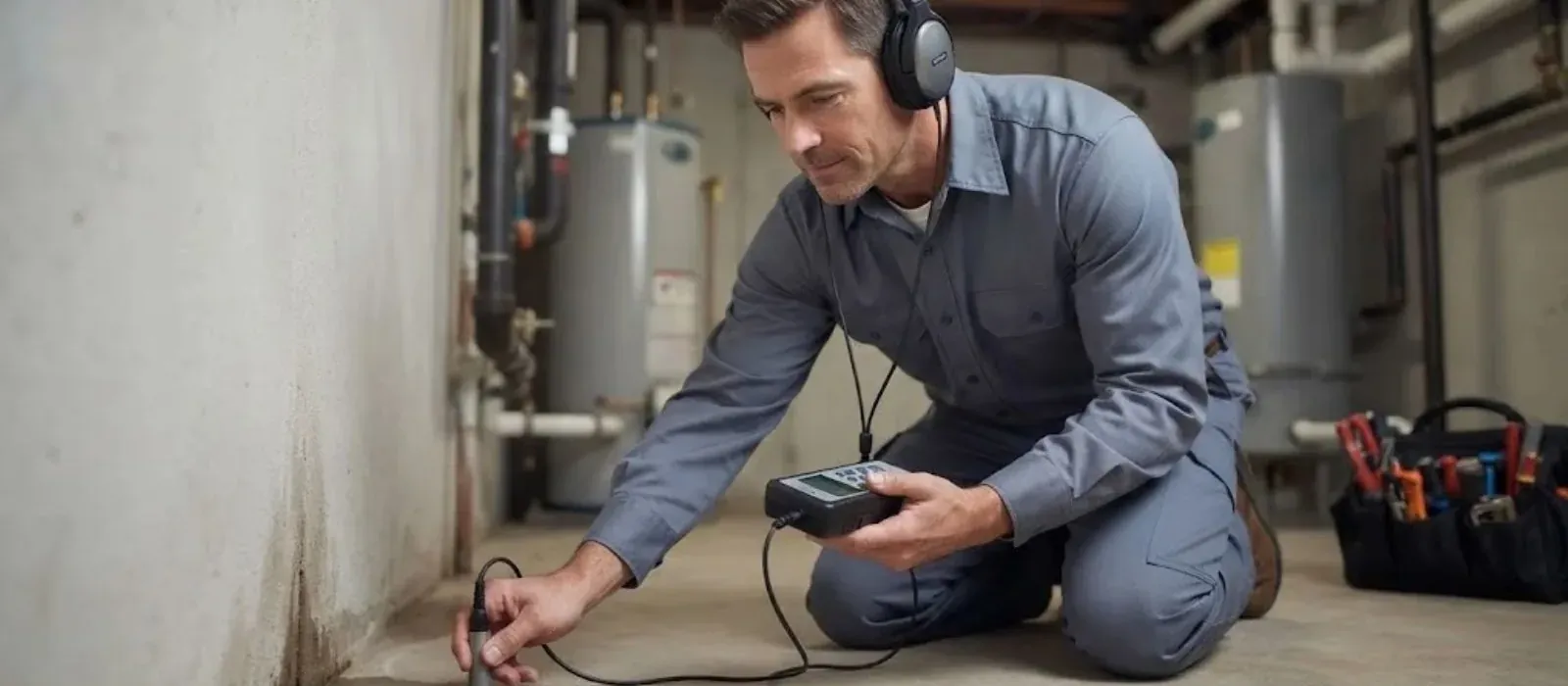
Acoustic listening
A sensitive microphone or ground mic picks up the hiss of pressurized water escaping, so a plumber can narrow a leak to a short stretch of pipe without cutting anything open.
Thermal camera
Hot-water leaks leave warm patches in floors and walls, and cold leaks leave cool ones. The camera shows the pattern before any hole is cut.
Moisture meter
Pins or a flat pad measure dampness in drywall, wood and concrete, which confirms what the camera suggests.
Pressure test
The plumber isolates a section of pipe and watches the gauge. A falling needle with no water in use means that section leaks.
Tracer gas
A harmless mix of gases is pushed into a drained line. A sensor picks up where it escapes, which helps with slab and buried-line leaks.
Seeing a high bill or a damp spot?
Tell us what you see and what your meter test showed. We explain which tools fit your situation and state a clear price before work starts.
What a good detection visit includes
Ask for these before the visit ends
- A named cause or a narrowed area, not just a guess at the general region
- The tools used, so you know which method gave the answer
- Photos or readings, such as thermal images or gauge results
- A repair option or two, with the trade-offs explained
- A written note you can hand to an insurer or a home inspector
If the leak turns out to be in the line from the street, our leak detection service and water line repair page cover how those jobs go, including who digs and what the utility has to say.
Does insurance cover finding the leak
It depends on the policy. The Connecticut Insurance Department says internal water damage such as a burst pipe is generally handled under homeowners insurance. Slow leaks and wear are usually excluded, and the cost of finding a leak may or may not be covered when the leak itself is not.
Call your agent before the visit if you suspect damage already happened. Ask whether detection and access are covered, and keep the written report.
Farmington's water systems and your bill
Which water system reads your Farmington meter
Farmington is served by more than one water system. Connecticut Water runs the Unionville system, the Avon system (which serves Avon, Farmington and Simsbury from groundwater wells) and the Chimney Hill system, which is Farmington only and buys its water from the Metropolitan District Commission.
Your bill tells you which one is yours, and that decides who to call about a spinning meter or a surprise bill. Ask your utility where its responsibility ends before you pay for work between the meter and the street. Connecticut Water's customer line is 1-800-286-5700.
Source type: utility water-quality reports and state drinking water schedule
Leaks in Plainville and Avon homes
Plainville homes get water from Aquarion's Plainville Regional system, which draws on groundwater wells. Utility-reported data compiled by TapWaterData lists about 9.5 grains per gallon, classed hard. A Bristol Press article on the town's water notes that hard water can lead to scale inside pipes and fixtures. That is one reason a quiet dripping valve or a toilet that refills on its own deserves a look in the Plainville area.
Housing figures compiled from Census survey data suggest many Plainville homes predate 1980, so older piping is common there.
In Avon, Connecticut Water's Avon system draws on groundwater wells, and it also serves parts of Farmington and Simsbury. Some properties use septic systems, and the Farmington Valley Health District requires a permit before any part of a septic system is altered or repaired. A soggy patch of lawn near a septic tank may not be a water line at all. A plumber serving the Avon area can tell the difference with a pressure test and a camera.