
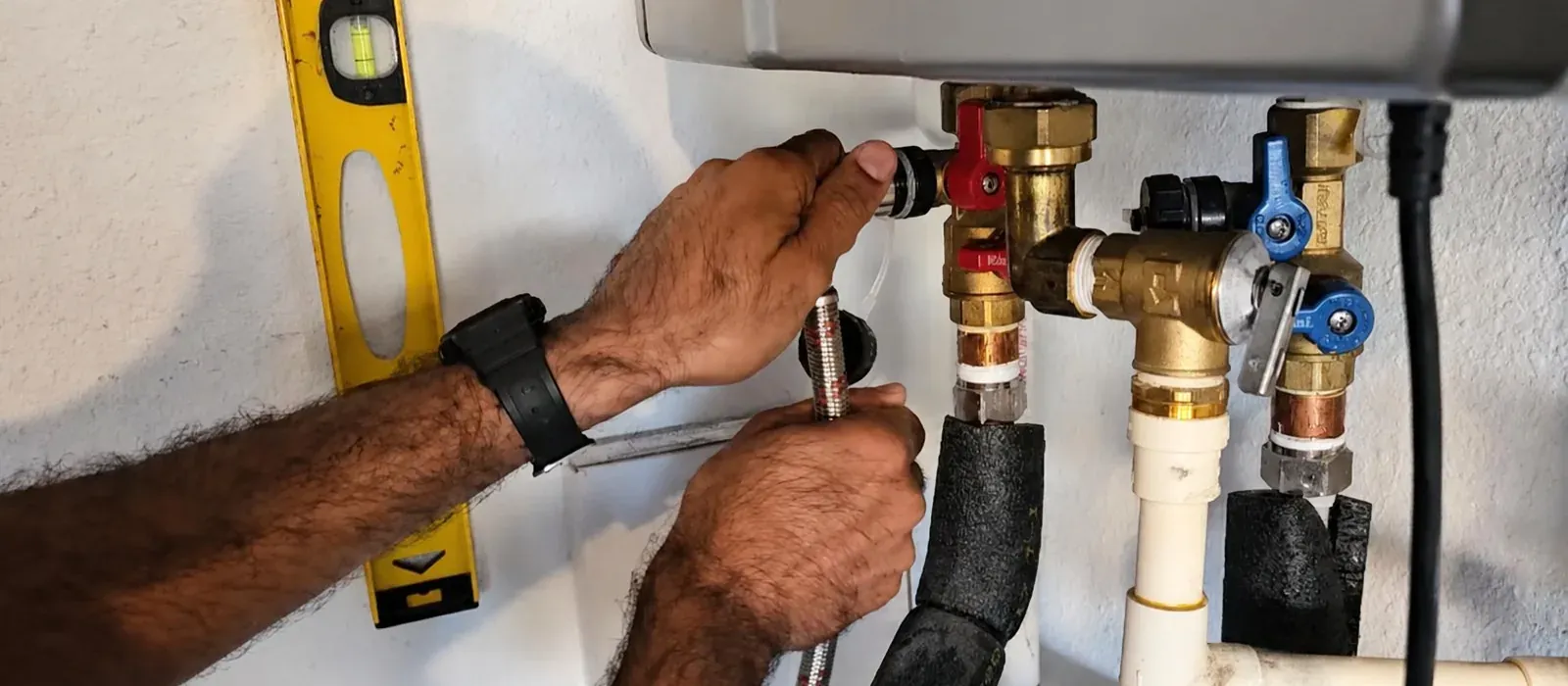
Four checks that decide if tankless fits your house
Tankless units are compact and do not run out of hot water the way a tank can. They also ask more of your house. A gas unit needs a gas line that can deliver a big burst of fuel plus a vent that can carry exhaust outdoors. An electric unit needs heavy circuits and room in the panel.
If any of those pieces falls short, the installation grows into a larger job. A good plumber checks them during the first visit, before the quote.
What to confirm before you buy a unit
- Fuel at the house: natural gas, propane, oil-fired boiler or all-electric.
- Gas line capacity: the pipe size, run length and meter must support the unit and your other gas appliances running together.
- Vent path: a route to an outside wall or roof that meets the manufacturer's clearances.
- Electrical room: for electric units, spare breaker space and wire sized for the load, installed by a licensed electrician.
- Hot water demand: how many showers, a dishwasher and a laundry load might run at once.
Gas or electric: how the two compare
| Question | Gas tankless | Electric tankless |
|---|---|---|
| Fuel supply | Natural gas or propane line sized for a high burst of fuel | Dedicated high-amperage circuits from the panel |
| Venting | Required, with materials set by the maker | None needed |
| Large flow in winter | Usually keeps up with several fixtures | Can struggle when incoming water is very cold |
| Biggest hidden cost | Gas line upgrade and venting through walls | Panel upgrade and heavy wiring |
| Best fit | Homes already on gas with a practical vent path | Small loads, apartments, a distant fixture |
Neither type is better in general. The better choice is the one your house can support without major rebuilding. A quick survey of the meter, the panel and the likely vent path will usually point to one answer.
Gas line capacity: the question people skip
A tankless gas unit can demand much more fuel at once than a tank burner. The line feeding it has to be large enough for the full run length, and the meter has to handle that unit plus a furnace, range and dryer if they run together. Many older homes have a line sized for a tank heater, and it may not be enough.
Only a licensed professional should size, modify or connect gas piping, and the gas utility may need to review the load. If you ever smell gas, leave the building and call the gas utility or 911 before you call a plumber.
Venting basics for a gas tankless unit
Condensing units
They pull more heat from exhaust and run cooler, so they typically use plastic vent pipe and need a way to drain acidic condensate. Follow the maker's list of approved materials.
Non-condensing units
Hotter exhaust means stainless steel venting and stricter clearances. This is the type that can be hard to retrofit in an interior utility closet.
Termination point
Where the vent exits the house matters for snow, windows and air intakes. Winter drifts can block a low wall termination, so ask about height.
Combustion air
A unit may draw air from the room or from outside through a second pipe. A tight basement or closet changes which setup works.
Code for tankless installs
Connecticut's 2022 State Building Code adopts the 2021 International Plumbing Code (IPC), and electric units must also meet the 2020 National Electrical Code (NEC) that Connecticut adopted. Ask any installer how both apply to your house.
Ready to find out if your gas line and vent path work?
A licensed plumber can look at the meter, pipe run, panel and the spot you have in mind, then explain the options. Call (860) 397-8103 for a clear price before work starts.
What Farmington's fuel mix tells you
American Community Survey figures for 2020 to 2024 show how Farmington households heat: fuel oil or kerosene in 40.6 percent, utility gas in 36.2 percent, electricity in 15.3 percent and bottled gas in 6.0 percent. That is heating fuel, not water heating, but it tells you what is likely at the house.
If you heat with oil, gas may not be piped to your street at all, and an electric tankless or an indirect tank on your boiler may be the practical routes. Gas heat homes have the easiest start for a gas unit. Bottled gas homes need a propane supply sized for the load.
Good candidates for a gas tankless
- Utility gas already at the meter
- Line size confirmed for the new load
- A short, clear path to an outside wall
- High hot water demand at peak times
Cases to look at carefully
- Oil heat and no gas service at the street
- A crowded panel with no spare breaker space
- An interior closet with no vent route
- Very low demand, where a tank may be enough
If you want the full option list, our tankless water heater page covers the equipment, and water heater installation explains how tank and tankless jobs are planned.
Winter flow, flushing and mineral buildup
Incoming water is coldest in winter, so a tankless unit has to lift it further. NOAA's 1991 to 2020 normals at Bradley Airport put the January average low at 18.8 F. That is an airport reading, not Farmington itself, but it is a reminder to size for winter flow rather than a mild day.
Mineral scale shrinks the heat exchanger passages over time. Flushing with a descaling solution on the maker's schedule protects the unit. To know what your tap carries, test it, and ask your water utility for its annual water quality report.
Three water systems and a state code, one town
Farmington is served by more than one water system. Connecticut Water's Unionville and Avon systems serve parts of town, and the Chimney Hill system buys its water from the MDC. Your bill shows which system you are on. Ask that utility for its report before you choose a descaling routine.
On permits, Connecticut's 2022 State Building Code says altering or replacing a plumbing system regulated by the code needs an application to the building official, and boilers and water heaters are also governed by state regulations under chapter 540. Whether your job needs a permit varies, so call the Farmington Building Department.
Source type: utility water-quality reports and state building code
How the job is priced
What drives the price of a tankless installation
Quotes differ more for tankless than for a like-for-like tank swap, because the surrounding work varies so much.
Nearby towns, different utilities
Utilities change over short distances. In West Hartford, the MDC reports low calcium, an average of 3.09 ppm in its 2025 report, and the town adopted the 2021 International Plumbing Code. In Bristol, the city's Water and Sewer Department supplies the water and its permit page says plumbing work may need a permit, so each town gets its own call.