
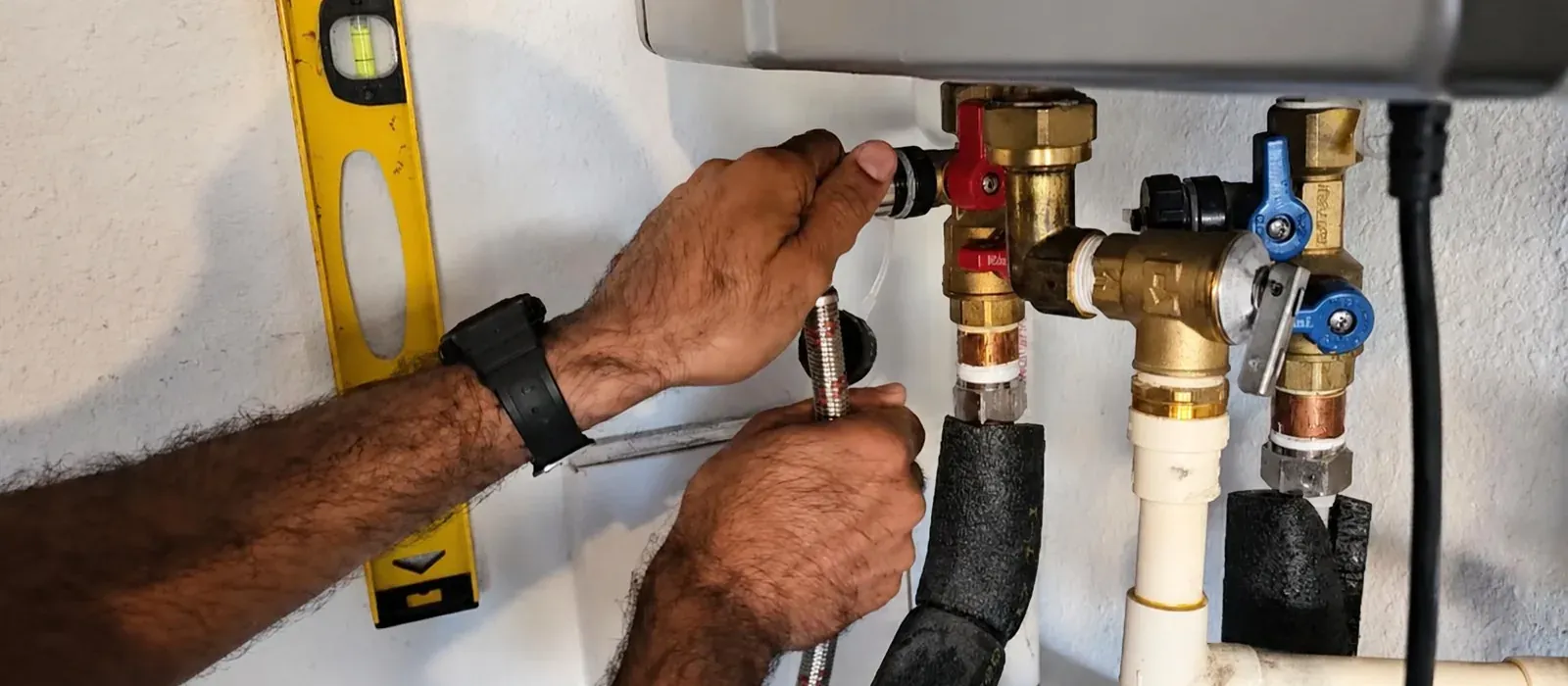
Why a tankless unit needs flushing at all
Cold water enters a tankless heater, passes over a heat exchanger and leaves hot. Any dissolved minerals in that water can bake onto the metal as scale. A thin coat is harmless. A thick coat narrows the passages, slows the flow and makes the burner or elements work harder for the same temperature.
You usually notice it before you see it. Hot water takes longer to arrive, the temperature swings, the unit throws an error code or you hear popping and rumbling inside the cabinet. Those symptoms can also come from other faults, so scale is a likely suspect, not a guaranteed one.
Flushing is maintenance, not a repair
Think of it the way you think of an oil change. It removes buildup before the buildup causes damage. If the unit is already failing, a flush may not fix it, and a technician should look at the burner, sensors and venting. The tankless water heater page explains how those parts work and what a service visit covers.
What you need before you start
Gather these first
Most of this fits in a bucket. Check your manufacturer's manual for anything specific to your model.
- Isolation valves: Three-way valves on the hot and cold lines with service ports. If your unit has none, a plumber can add them, and that is worth doing before your first flush.
- A small submersible pump: A utility pump that fits a 5 gallon bucket, plus two washing machine style hoses with female ends.
- A 5 gallon bucket and a drain path: You will circulate liquid in a loop, then rinse. Know where the rinse water goes.
- Your cleaning liquid: Either white vinegar or a descaling product made for tankless heaters (more on that below).
- The manual: It lists the solution amount and soak time your manufacturer accepts, and it may list a different procedure than the one here.
The flush, step by step
Shut off power and fuel
Turn off the electric supply at the breaker or unplug the unit. For a gas model, close the gas shutoff on the line to the heater. If you smell gas at any point, leave the house and call the gas utility or 911 before you call a plumber.
Close the water and open the service ports
Turn the isolation valve handles so the heater is cut off from the house piping. Open the pressure relief port on the hot side to release trapped pressure. Expect a little water to spill, so keep a towel handy.
Connect the hoses and the pump
Attach one hose from the pump outlet to the cold-side service port and the other from the hot-side port back into the bucket. Pour in the cleaning liquid so the pump intake is covered.
Circulate the solution
Run the pump for the time your manual calls for. The liquid pushes through the heat exchanger and back to the bucket. Cloudy or tinted liquid means scale is coming off.
Rinse with fresh water
Drain the bucket, close the hot-side service port and open the cold-side valve to flush clean water through to the bucket or a floor drain. Rinse until the water runs clear and no longer smells of vinegar.
Clean the inlet screen and restore service
Many units have a small filter screen at the cold inlet. Pull it, rinse it and put it back. Reset the valves to normal, open a hot tap to purge air, then restore fuel and power.
Vinegar or a descaler: choose carefully
White vinegar is the common household answer. It is mildly acidic, cheap and easy to find, and many homeowners use it without trouble. The catch is that some manufacturers specify their own descaling solution or limit how long any acid can sit in the unit.
Check the manual and your warranty terms before you pour anything in. If the paperwork names a product, use that one. If it allows vinegar, follow the stated time rather than leaving it overnight. Never mix vinegar with bleach or other cleaners, because the fumes can be dangerous.
White vinegar
- Easy to buy and easy to rinse out
- Often accepted by manufacturers, but not by all
- Works best on light to moderate scale
- Strong smell, so ventilate the room
- Longer soaks can be hard on some components
Tankless descaler product
- Made for heat exchangers and sold for that use
- May be the only product your warranty accepts
- Follow the label for dilution and contact time
- Costs more than vinegar
- Still needs a full fresh water rinse afterward
Mistakes that damage the unit
Skipping the power and fuel shutoff
Running a pump through a heater that can fire is how you burn out a heat exchanger. Always cut power and fuel first.
Leaving the solution in too long
More time is not better. Stay inside the manufacturer's window, then rinse well.
Forgetting to purge air
Air left in the lines can trigger error codes at startup. Open a hot tap until the flow runs steady.
Forcing stuck valves
An old isolation valve that will not turn can snap. Stop and have a plumber replace it rather than risk a flood.
Follow the manufacturer's guidelines
Every maker publishes flush guidelines for its own model, and the 2021 International Plumbing Code (IPC) that Connecticut adopted in 2022 expects service to follow them. Check your manual before you start, and stop if the instructions differ from this guide.
Stuck valve, error code or no hot water?
If the flush does not clear the problem, or the isolation valves will not budge, a licensed plumber can service the unit and get you a clear price before work starts.
How often to flush, and why your tap matters
Manufacturers set the interval in the manual, and it varies with the model and with how much mineral your water carries. Some say once a year. Others suggest more often in areas with a lot of dissolved minerals.
So the real question is what is in your water. You can test the tap yourself with a simple home kit, and you can ask your water utility for its annual water quality report. Both give you a better basis than guessing. If the test or the report points to a lot of minerals, flush on the shorter end of your manufacturer's range.
Three water systems serve Farmington
Farmington is not on one water system. Connecticut Water's Unionville and Avon systems serve parts of town, and the Chimney Hill system, which buys its water from the Metropolitan District Commission, serves Farmington customers only. Your water bill shows which one is yours.
The 2025 consumer confidence reports for those three systems do not list a hardness figure, so do not assume a number for your street. Call Connecticut Water at 1-800-286-5700 or read your system's report, then use your own tap test to set the flush schedule.
Source type: utility water-quality reports
When to stop and call a plumber
| What you see | Likely cause | Best next step |
|---|---|---|
| Slow hot water, mild temperature swings | Scale on the heat exchanger | Flush with isolation valves, then retest |
| No isolation valves on the unit | Never installed | Have a plumber add them before flushing |
| Valve handle will not turn or leaks when turned | Corroded or worn valve | Stop. Call a plumber to replace it |
| Error code returns right after a flush | Sensor, vent or burner fault | Book a water heater repair visit |
| Water leaking from the cabinet | Failed connection or cracked part | Shut off water and power, then call |
| Gas smell or soot at the vent | Combustion or venting problem | Leave the building, call the gas utility or 911 |
Gas lines, venting and electrical connections are licensed work in Connecticut. A homeowner flush is fine, but anything that opens a gas fitting or alters the vent belongs with a licensed plumber. You can check a license on the state's eLicense lookup at elicense.ct.gov before you hire.
Neighbors in Avon and Plainville face the same questions. In Plainville, utility-reported data compiled by TapWaterData lists about 9.5 grains per gallon, which that source classes as hard, so a unit there may build scale faster than a manual's average case.